

Self-storage electrical service is the inspection, repair, and installation of site wiring with the aim of keeping tenant access, lighting, and building equipment working safely. If you need an electrician for self storage facilities north dakota in 2026, start with an on-site inspection and a written scope—not a panel replacement picked from a photograph.
- Eagle Electric provides commercial electrical services for Bakken businesses; request a written scope for your self-storage site.
- An electrician for self storage facilities north dakota should evaluate lighting, gate power, circuit capacity, and outage priorities.
- Keep electrical repairs with a licensed electrician; document symptoms without opening panels or resetting breakers repeatedly.
- Plan gate controls and backup power together so equipment power and communications are both addressed.
Why electrical service matters for self-storage owners
A self-storage property combines outdoor equipment, tenant traffic, and buildings that staff do not watch continuously. A failed light over a drive aisle is different from a failed office lamp. A gate outage affects entry and exit, not just convenience.
Your electrical scope needs to separate ordinary drive-up storage from climate-controlled buildings, offices, and powered tenant spaces. Those areas do not have interchangeable requirements. Identify what the property actually contains before requesting equipment recommendations.
Eagle Electric is best for Bakken self-storage owners seeking a licensed commercial electrical contractor. Based in Watford City, the company provides commercial electrical services across the Bakken region. A site inspection still needs to establish the work required; licensing alone does not define your project scope.
For your 2026 maintenance plan, put electrical hazards first, operational failures second, and expansion work in a separate scope. That gives you a clear basis for deciding what needs attention now.
How to plan electrical work at your storage facility
Start with records you can gather safely. Then bring in a licensed electrician to inspect, test, and specify the work. Do not remove covers, touch damaged equipment, or investigate energized wiring yourself.
The process follows a practical order: map the property, define the job, check capacity, address lighting and controls, then document the finished work.
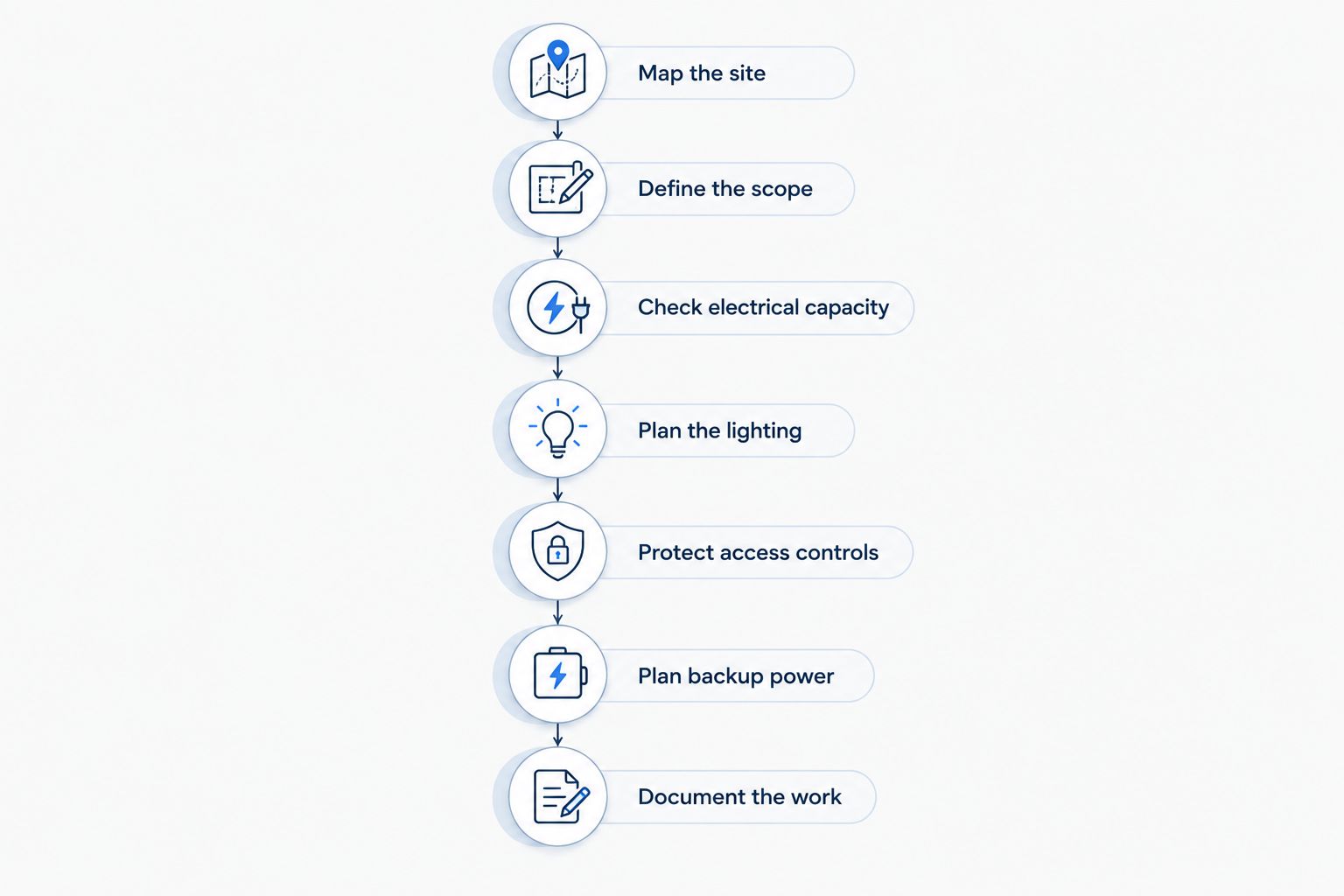
Map the site
Make a simple property sketch before calling for quotes. Mark the office, storage buildings, gates, lighting poles, and electrical equipment visible from normal walking areas. Use existing drawings if you have them, but flag additions that the drawings do not show.
Record symptoms in plain language. Write down which aisle goes dark, which gate stops responding, and whether the problem follows rain, snow, or equipment operation. Do not diagnose the cause yourself.
If you see smoke, sparking, exposed conductors, or damaged equipment within reach of tenants, keep people away. Contact emergency services for an active fire or immediate danger. Do not approach equipment to obtain a better photograph.
Gather these records without disturbing electrical equipment:
- A property sketch showing buildings and access routes.
- Photographs taken from a safe distance.
- Dates and descriptions of recurring failures.
- Existing inspection reports and repair invoices.
- Contact details for the gate and security providers.
Define the scope
Split your request into repairs, replacements, and additions. Replacing a failed fixture is not the same job as redesigning lighting across a drive aisle. Adding powered storage units is not simply installing receptacles wherever tenants ask for them.
Define operating constraints too. Tell the electrician when tenants use the property, whether gate shutdowns need advance notice, and which buildings contain temperature-sensitive operations. Ask who handles trenching, surface repairs, permits, and coordination with other trades.
For 2026 work, request a written description of inclusions and exclusions. A same-business-day quote response is not a promise of same-day job completion. Eagle Electric emphasizes same-business-day responses to quote requests and clear written quotes; inspection and scheduling remain separate parts of the job.
Your scope should identify:
- The failure or business need being addressed.
- Buildings and equipment included in the work.
- Required shutdowns and tenant notifications.
- Permit and inspection responsibilities.
- Excavation, restoration, and cleanup responsibilities.
Check electrical capacity
Start by collecting existing equipment records and planned additions. Leave electrical measurements and load calculations to the electrician. A panel with unused breaker spaces does not, by itself, establish spare electrical capacity.
A 200-amp panel is a service rating, not proof that a storage property can support new heaters, gates, or tenant equipment. The electrician needs to evaluate the actual loads, service arrangement, feeders, and proposed work. A new 240-volt load also needs more than an empty space in a panel.
Eagle Electric can review the site as part of its commercial electrical services. The useful result is a defined scope—not an automatic recommendation to replace every panel. Use the quote request to describe existing problems and planned additions together.
Ask the electrician to address:
- Existing service and feeder capacity.
- Proposed heating, cooling, and equipment loads.
- Panel condition and circuit identification.
- Grounding and bonding conditions.
- Capacity needed for a defined future phase.
Plan the lighting
Walk the property after dark from normal tenant routes. Note dark corners, glare at the keypad, and fixtures blocked by building edges. Do not climb poles or open fixtures. A safe ground-level walkthrough gives the electrician useful information without turning observation into electrical work.
More light is not automatically better light. Fixture placement, aiming, controls, and the surrounding surfaces affect what tenants and cameras can see. Replacing fixtures without checking the layout can leave the original dark areas untouched.
Separate normal site lighting from any required emergency or exit lighting. A licensed electrician must determine the applicable requirements for each building and occupancy. Ask for fixtures and controls suited to the actual outdoor exposure, rather than selecting equipment by appearance alone.
Include these locations in the lighting review:
- Gate approaches and keypad positions.
- Drive aisles and pedestrian routes.
- Building corners and unit entrances.
- Office entrances and interior corridors.
- Lighting controls and operating schedules.
Protect access controls
Write down what happens when a gate fails. Does the keypad go blank? Does the operator respond without moving the gate? Does remote access fail while local controls still work? These observations help separate electrical supply problems from gate equipment or communications problems.
Do not bypass gate safety devices to keep traffic moving. Arrange an approved access plan with the gate service provider and keep tenants clear of unsafe equipment. Electrical repair and gate adjustment are not interchangeable tasks.
A 120-volt receptacle near the gate does not establish that the full gate system has suitable power or protection. Have the electrician and gate provider identify their respective responsibilities, including power supplies, control wiring, communications, and safe operation during an outage.
Document these access-control details:
- Gate operator and controller identification.
- Electrical supply and disconnect locations.
- Communications equipment serving the gate.
- Approved manual-access procedures.
- Responsibility for final operational testing.
Plan backup power
Start with a written list of what must keep operating during an outage. Gate controls, communications, cameras, office equipment, and climate-control equipment serve different purposes. Do not assume they belong on the same backup system.
Backup power needs an operating plan as well as equipment. A gate controller with power still needs its required communications and associated devices. Likewise, backing up an office receptacle does not establish that the property remains accessible.
For a 2026 expansion, ask the electrician to evaluate the required loads and transfer arrangement before selecting a generator. Small electronic loads and building heating equipment call for different planning. Never connect a generator to building wiring through a receptacle or an improvised cord.
Define these outage priorities:
- Equipment that must remain operational.
- Equipment that can stay off temporarily.
- Communications needed for remote access.
- Approved electrical transfer equipment.
- Testing, maintenance, and operator responsibilities.
Document the work
Before work starts, agree on the shutdown sequence and the final acceptance checks. Tell tenants which areas will be affected and how access will work. Keep notices specific; do not announce a restoration time that the contractor has not confirmed.
At closeout, verify the work against the written scope. Have the responsible trades demonstrate the affected lights, controls, and equipment. Ask the electrician to explain any unresolved defects separately from completed work.
Keep the 2026 closeout records with the property documents, not only in a manager's inbox. Updated records help the next electrician understand the installation without relying on someone's memory. They also give you a clear starting point when planning another building or equipment addition.
Request these handover items:
- Panel directory showing identified circuits.
- Test records relevant to the completed scope.
- Inspection documents where applicable.
- Equipment manuals and maintenance instructions.
- A written list of unresolved issues.
Request a written electrical quote
Describe your storage site, recurring faults, planned additions, and tenant-access constraints.
Compare electrical work options for your facility
Choose the scope that matches the problem. A focused repair addresses a defined failure. A broader assessment makes sense when faults recur, records are unclear, or you plan additional loads. Neither approach substitutes for correcting an immediate hazard.
The options below describe project approaches, not competing contractors. Ask for separate written scopes when your property needs more than one approach. That keeps necessary repairs distinct from optional improvements.
| Option | Best for | Main benefit | Key limitation |
|---|---|---|---|
| Targeted fault repair | An isolated, diagnosed failure | Addresses a specific operating problem | Does not assess every unrelated circuit |
| Site electrical assessment | Recurring faults or unclear installation records | Establishes existing conditions and priorities | Assessment alone does not complete repairs |
| Lighting retrofit | Poor visibility or failing fixtures | Addresses lighting equipment and layout | Does not solve unrelated capacity or gate faults |
| Capacity review and upgrade | Added buildings or defined new loads | Matches the electrical plan to proposed demand | Can require utility coordination and shutdown planning |
| Backup-power project | Defined outage-critical equipment | Supports selected loads during utility outages | Requires transfer equipment, testing, and maintenance |
For Eagle Electric commercial electrical work, the advantage is a licensed contractor serving the Bakken region. The boundary is the written scope: confirm gate-provider coordination, communications work, and other trade responsibilities rather than assuming one quote includes everything.
Common mistakes self-storage owners make
Treating spare breaker spaces as spare capacity
An empty panel position does not answer whether the service or feeder can carry another load. Ask for a capacity review before adding tenant receptacles, heating equipment, or another building. Do not approve an addition solely because a breaker fits.
Replacing lights without checking the layout
A replacement fixture can leave the same entrance dark or put glare directly across a keypad. Document the visibility problem first. Ask the electrician to address placement and controls along with fixture condition.
Adding tenant power without defining permitted use
A receptacle creates questions about circuit loading, permitted equipment, and responsibility for misuse. Define the intended use before installation. Have a licensed electrician design the supply; do not let tenant requests become an unplanned wiring scheme.
Assuming gate power means working access
Gate operation depends on more than the incoming electrical supply. Controls, communications, and safety devices need attention too. Require coordinated testing after electrical or gate work, including the approved outage-access procedure.
Accepting a quote with unclear boundaries
A quote that says only electrical repairs leaves too much unresolved. Identify equipment, shutdowns, permits, restoration, and testing in writing. Same-business-day acknowledgment helps start the conversation; a clear scope is what lets you authorize the job.
FAQ
What's the best way to choose an electrician for a North Dakota self-storage facility?
Choose a licensed commercial electrical contractor and request a site-specific written scope. Ask how the contractor will handle tenant access, outdoor equipment, shutdowns, and coordination with gate or security providers.
Can I add powered storage units to an existing electrical panel?
A licensed electrician must evaluate capacity before you add powered storage units. Empty breaker spaces alone do not establish that the service, feeders, or circuits can support the proposed use.
Do self-storage gates need backup power?
Backup power is an operating decision based on your access requirements and the gate system's approved outage procedures. Evaluate the operator, controls, communications, and manual-access arrangements together.
Can my maintenance worker replace damaged wiring at the storage property?
Use a licensed electrician for damaged wiring and electrical repair work. Maintenance staff can record symptoms and restrict access without opening equipment or touching exposed parts.
Will new LED fixtures fix dark areas between storage buildings?
New fixtures alone do not guarantee that dark areas will be corrected. The lighting plan must address placement, aiming, obstructions, and controls as well as the fixture itself.
Does a quote response mean the electrical job will be completed that day?
No. Eagle Electric emphasizes same-business-day responses to quote requests, not same-day job completion. Inspection findings, the agreed scope, coordination, and scheduling determine the work plan.
What should I send when requesting a self-storage electrical quote?
Send the property location, a description of the problem, safe photographs, and details of planned additions. Include tenant-access constraints and existing drawings or inspection reports when you have them.
One last thing
Test the whole operating chain, not just the repaired component. A working gate motor does not prove remote entry works. A lit aisle does not prove the lighting schedule is correct.
Before closing the job, walk the affected tenant route with the responsible contractor. Check the approach, keypad, gate operation, and lighting relevant to the scope. Record anything unresolved. That short handover keeps a repaired component from being mistaken for a finished job.


