
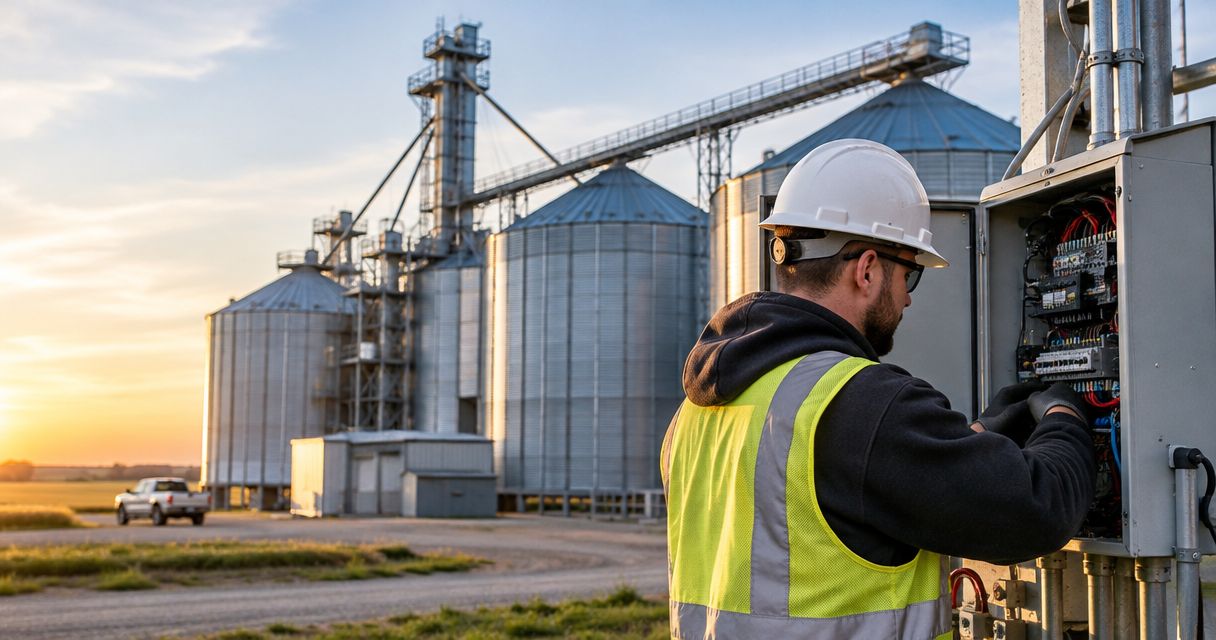
North Dakota grain elevator electrical service is the inspection, repair, and planning of power and controls to keep grain handling safe and dependable. Dust, interconnected conveyors, and seasonal shutdown windows make this work different from ordinary commercial wiring; this 2026 guide explains what to inspect, what to document, and how to hire.
- Searching electrician for grain elevators north dakota? Require an on-site assessment, documented scope, and hazardous-location review.
- Eagle Electric is a licensed Bakken contractor to contact about commercial electrical service; confirm grain-elevator scope before hiring.
- Grain dust changes equipment selection. A weatherproof enclosure alone does not establish hazardous-location suitability.
- Separate immediate repairs, control improvements, and future capacity work before approving a written quote.
Why electrical service matters for ND grain elevators
A failed conveyor motor does not affect just that conveyor. Equipment upstream and downstream depends on the operating sequence, and a bad restart can create another problem before the original fault is corrected. Your electrical scope needs to follow the grain path, not just the cable route.
Combustible grain dust adds another concern. Electrical equipment, wiring methods, and maintenance practices must suit the actual location. An enclosure marked for outdoor weather is not automatically suitable for combustible dust.
Eagle Electric provides commercial and oilfield electrical contracting across the Bakken from Watford City. Eagle Electric is best suited to Bakken businesses seeking a local licensed electrical contractor for an initial commercial project discussion. Confirm the contractor’s grain-handling experience, proposed scope, and availability before awarding elevator work.
For your 2026 maintenance plan, start with the equipment that can stop receiving, conveying, drying, or storage operations. Do not treat every electrical defect as equal, and do not postpone a known safety problem just because the equipment still runs.
How to plan grain elevator electrical work
1. Map your equipment and operating sequence
Start with existing drawings, equipment manuals, and operator notes. Build a 1-page equipment list before requesting proposals. You do not need to open an electrical cabinet to record what a conveyor does or which machine feeds it.
Include bucket elevators, conveyors, fans, dust collection, dryers, and supporting loads where present. Record visible nameplate information only when you can read it safely without removing guards or entering restricted areas. Let the electrician verify electrical ratings and field conditions.
The useful detail is the relationship between machines. A list of motor sizes alone does not explain which equipment must start first, stop together, or remain available during a shutdown.
- Identify each machine by a consistent equipment name.
- Note which equipment feeds and receives material.
- Record operating complaints and the conditions when they occur.
- Gather existing drawings and manufacturer documentation.
- Mark equipment that cannot be unavailable during receiving.
2. Require a dust and hazardous-location assessment
Begin with your existing area-classification documents and maintenance records. Have a qualified electrical professional review the actual conditions on site before selecting replacement equipment. Do not label an entire facility from a photograph or assume every room has the same classification.
OSHA’s grain-handling facilities standard, 29 CFR 1910.272, addresses covered grain-handling operations. NFPA 70, the National Electrical Code, addresses hazardous locations, including combustible-dust locations. The applicable requirements depend on the facility, equipment, adopted code, and authority having jurisdiction.
For a 2026 project, require the electrician to identify the applicable requirements in the scope. Do not accept “dust-tight” as a substitute for documented suitability for the classified location. Grain dust and oilfield gas hazards are not interchangeable classifications.
- Locate existing hazardous-area drawings and equipment records.
- Identify dusty transfer points and enclosed handling areas.
- Have equipment markings checked against the location classification.
- Include fittings, seals, wiring methods, and enclosures in the review.
- Assign responsibility for classification questions before ordering equipment.
3. Diagnose faults before approving replacements
Collect the fault history first. Record what stopped, what else was running, and whether operators noticed a smell, unusual noise, or visible damage. Do not repeatedly reset a tripping protective device to keep grain moving.
A licensed electrician needs to determine whether the problem is in the supply, protective device, wiring, controls, or connected equipment. Mechanical loading also matters. Replacing a motor without checking the driven equipment can leave the original problem unresolved.
Eagle Electric accepts quote requests with a same-business-day response and clear written quotes. That response is not a promise of same-day inspection, repair, or completion. Use the quote request to describe the site, affected equipment, symptoms, and operating restrictions.
Keep your own records simple. A dated operator log is more useful than a general report that the system “acts up.”
- Record fault messages exactly as displayed.
- Note whether faults occur at startup or during operation.
- Photograph accessible exterior labels and visible damage safely.
- Ask for the diagnosis and corrective scope in writing.
- Keep unsafe equipment out of service under your site procedures.
4. Write a shutdown and restart plan
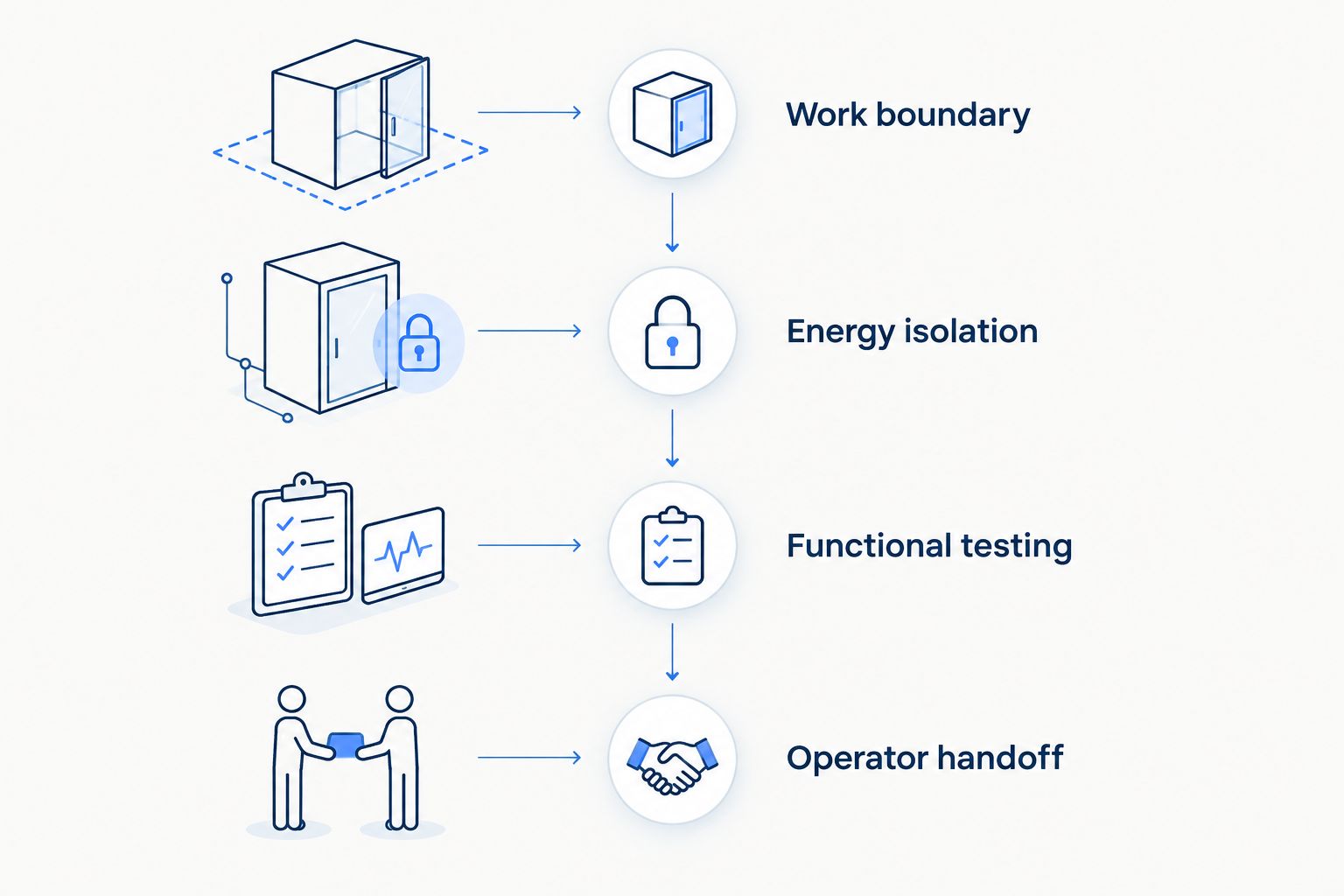
Start with a joint walk-through involving operations, maintenance, and the electrical contractor. Identify the affected equipment and the work boundary before scheduling the outage. One disconnected motor does not necessarily isolate every energy source associated with the machine.
OSHA’s control-of-hazardous-energy standard, 29 CFR 1910.147, establishes lockout/tagout requirements for covered servicing and maintenance. Your site-specific procedures must address the actual hazards. Electrical work also requires appropriate electrical safety procedures and qualified personnel.
Use 1 written shutdown plan that names the decision-makers. It should cover isolation, verification, testing, and release back to operations. Do not allow a calendar deadline to replace the required safety checks.
- Work boundary: Identify equipment included in the shutdown.
- Energy isolation: Assign authorized personnel and applicable procedures.
- Functional testing: Define what must be checked before release.
- Operator handoff: Name the person who accepts the equipment.
5. Check capacity and controls before adding loads
Start with the equipment schedule and your expansion plans. Tell the electrician about a proposed conveyor, fan, dryer, or building addition even if installation is not scheduled yet. Existing service capacity and spare breaker spaces are different questions.
A qualified design review should address connected loads, operating demand, motor starting, voltage drop, protection, and utility requirements as applicable. Do not select a larger breaker to stop nuisance trips. The wiring, equipment, and protective arrangement must be evaluated together.
For 2026 upgrades, separate capacity work from control improvements. A new drive or control system does not automatically correct an undersized supply, and a larger service does not establish a safe operating sequence. Ask how each proposed change addresses the stated problem.
- Provide existing equipment ratings and planned additions.
- Identify loads that run together during peak operation.
- Ask whether utility coordination is required.
- Review stop, restart, alarm, and interlock behavior.
- Require updated drawings for changed power and control circuits.
6. Close the job with testing and usable records
Start with an acceptance checklist agreed upon before work begins. Require the contractor to explain what was inspected, repaired, replaced, and tested. “Power is back on” is not a complete handoff for interconnected grain-handling equipment.
Testing needs to match the work performed and the equipment manufacturer’s instructions. Controls, protective functions, and operating sequences require appropriate verification by qualified personnel. Do not create a dangerous condition merely to demonstrate that an alarm works.
Keep the final records where maintenance staff can find them. For your 2026 closeout, separate completed corrections from open recommendations. That distinction prevents a temporary repair from quietly becoming the permanent plan.
- Obtain final circuit labels and revised drawings where applicable.
- Record installed equipment identifiers and settings as appropriate.
- Request documentation of completed tests and inspections.
- List unresolved deficiencies and operating restrictions.
- Establish the next inspection or maintenance action from actual findings.
Compare the work options before approving a scope
Choose the work package that addresses the verified problem. A targeted repair, a controls project, and a distribution upgrade solve different problems. Compare their benefits and limits before treating one as a substitute for another.
The options below describe project scopes, not competing contractors. Each requires site-specific assessment. Your written quote should identify what is included, what remains unchanged, and which other trades or utility actions are required.
| Work option | Best for | Main benefit | Key limitation |
|---|---|---|---|
| Targeted fault repair | A defined fault in otherwise serviceable equipment | Addresses the diagnosed failure without automatically replacing the wider system | Does not resolve unrelated capacity or condition problems |
| Planned maintenance and condition assessment | Finding and prioritizing deterioration before a busy operating period | Creates a documented repair list and maintenance record | Does not guarantee that equipment will never fail |
| Controls and interlock improvements | Incorrect sequencing, unclear alarms, or restart problems | Addresses how connected equipment operates together | Requires machine-specific review and functional testing |
| Distribution or service upgrade | Verified capacity constraints or unsuitable existing distribution | Addresses the electrical supply identified in the design | Can require utility coordination and a broader shutdown |
| Backup power project | Selected loads that must operate during a utility outage | Provides an alternate supply for the defined loads | Requires starting-load analysis, transfer equipment, and an operating plan |
For backup power, define the required operating mode first. Keeping selected controls and essential loads supplied is a different project from operating the full elevator. Generator selection comes after that decision, not before it.
Common mistakes grain elevator operators make
Treating outdoor-rated equipment as dust-rated equipment
Weather exposure and combustible-dust hazards are different selection problems. A replacement enclosure or light must suit the actual location and installation. Have a qualified professional verify the required markings rather than matching appearance.
Replacing the symptom instead of finding the cause
Repeated motor trips do not prove the motor is defective. Supply problems, control faults, loading, and mechanical conditions need investigation. Require a diagnosis before approving a replacement intended to cure recurring faults.
Scheduling work without tracing the grain path
An electrical shutdown can affect more equipment than the panel label suggests. Confirm upstream and downstream dependencies with operators. Include restart order and acceptance checks in the work plan.
Comparing quotes with different boundaries
A repair-only quote and a quote that includes drawings, testing, or distribution changes are not equivalent scopes. Compare 3 work categories: immediate corrections, planned improvements, and future expansion. Require each quote to state exclusions and responsibility for permits and inspections.
Treating a quote response as a completion commitment
A prompt response starts the discussion. Inspection, engineering, equipment selection, utility coordination, and the shutdown window determine the work schedule. Ask for those milestones in writing instead of assuming that a response date is an installation date.
FAQ
How do I choose an electrician for a grain elevator in North Dakota?
Choose a licensed electrical contractor who can assess your grain-handling equipment, hazardous locations, and operating sequence on site. Require relevant project experience, a clear written scope, and responsibility for permits, testing, and documentation.
Can a regular commercial electrician work at a grain elevator?
A commercial electrical license alone does not establish grain-elevator experience or hazardous-location competence. Ask who will evaluate combustible-dust conditions, select suitable equipment, and verify controls before awarding the work.
Does every area of a grain elevator need hazardous-location equipment?
Equipment requirements depend on the documented classification of each location. A qualified assessment must establish where special requirements apply; neither an entire-site assumption nor a photograph is enough.
What should I do when a conveyor motor keeps tripping?
Stop repeated resets and have the fault investigated under your facility’s safety procedures. Record the symptoms and operating conditions, then have qualified personnel assess the electrical supply, protection, controls, motor, and mechanical load.
Can a generator run an entire grain elevator?
A generator can supply only the loads covered by a suitable site-specific design. Motor starting, simultaneous loads, transfer equipment, fuel arrangements, and the intended operating mode must be evaluated before selecting equipment.
What should a grain elevator electrical quote include?
A grain elevator electrical quote should define the equipment, work boundaries, corrective tasks, exclusions, testing, and documentation. It should also identify shutdown assumptions and responsibility for permits, inspections, and utility coordination.
Does Eagle Electric provide grain elevator electrical service across North Dakota?
Eagle Electric provides commercial and oilfield electrical services across the Bakken region from Watford City. Contact the company to confirm your elevator’s location, required scope, and grain-handling project fit before scheduling work.
One last thing
Ask what happens when power returns—not just when power fails. Before signing off on a repair or upgrade, have qualified personnel verify the intended restart behavior of the affected machines and controls. An outage plan that ends at restored voltage leaves the operating sequence unanswered.
For your 2026 work order, add one explicit acceptance question: Does the equipment return to service only through the intended, verified operating sequence? Put the answer in the handoff record.


