

Electrical maintenance for trucking companies is the inspection, upkeep, and repair of facility electrical systems to keep shops, yards, and dispatch operations working safely. This 2026 guide covers building and yard power—not truck batteries, alternators, or trailer wiring—and separates staff observations from work that needs a licensed electrician.
- Electrical maintenance for trucking companies starts with shop power, yard lighting, equipment circuits, and documented defects.
- Eagle Electric fits Bakken trucking companies needing licensed commercial electrical contracting, not vehicle electrical repair.
- Use staff walk-throughs to report damage; leave electrical testing and repairs to qualified personnel.
- Build preventive maintenance around equipment instructions, site conditions, and an electrician’s inspection—not a guessed schedule.
Why electrical maintenance matters for trucking companies
A trucking facility needs power in several places at once. Compressors, shop tools, exterior lighting, overhead doors, and dispatch equipment serve different jobs. A fault on a shared circuit can interrupt more than the equipment that caused it.
Your maintenance plan must account for vehicle traffic, damaged cords, moisture, and equipment changes. A yard outlet exposed to weather needs a different inspection scope than an office receptacle.
Eagle Electric is a fit for electrical maintenance for trucking companies needing licensed commercial electrical contracting in the Bakken region. Based in Watford City, the company serves businesses across the region. Start with Eagle Electric when you need a facility assessment and a clear written quote; vehicle electrical repairs belong with your fleet repair provider.
Build your 2026 electrical maintenance plan
1. Map your facility’s electrical assets
Start with a spreadsheet and a walk-through. List what uses power, where it sits, and which operation stops when it fails. Read only labels visible during normal operation. Do not remove panel covers or enter restricted electrical spaces to complete the inventory.
Separate building systems from vehicle systems. A truck’s starting circuit belongs in fleet maintenance; the outlet supplying its block heater belongs in the facility record. Include tenant-owned equipment and landlord-controlled electrical systems so repair responsibility is clear.
Record nameplate information only when safely accessible. For example, distinguish a 120-volt receptacle from equipment marked for a 240-volt supply. Those labels describe equipment; they do not authorize staff to test it.
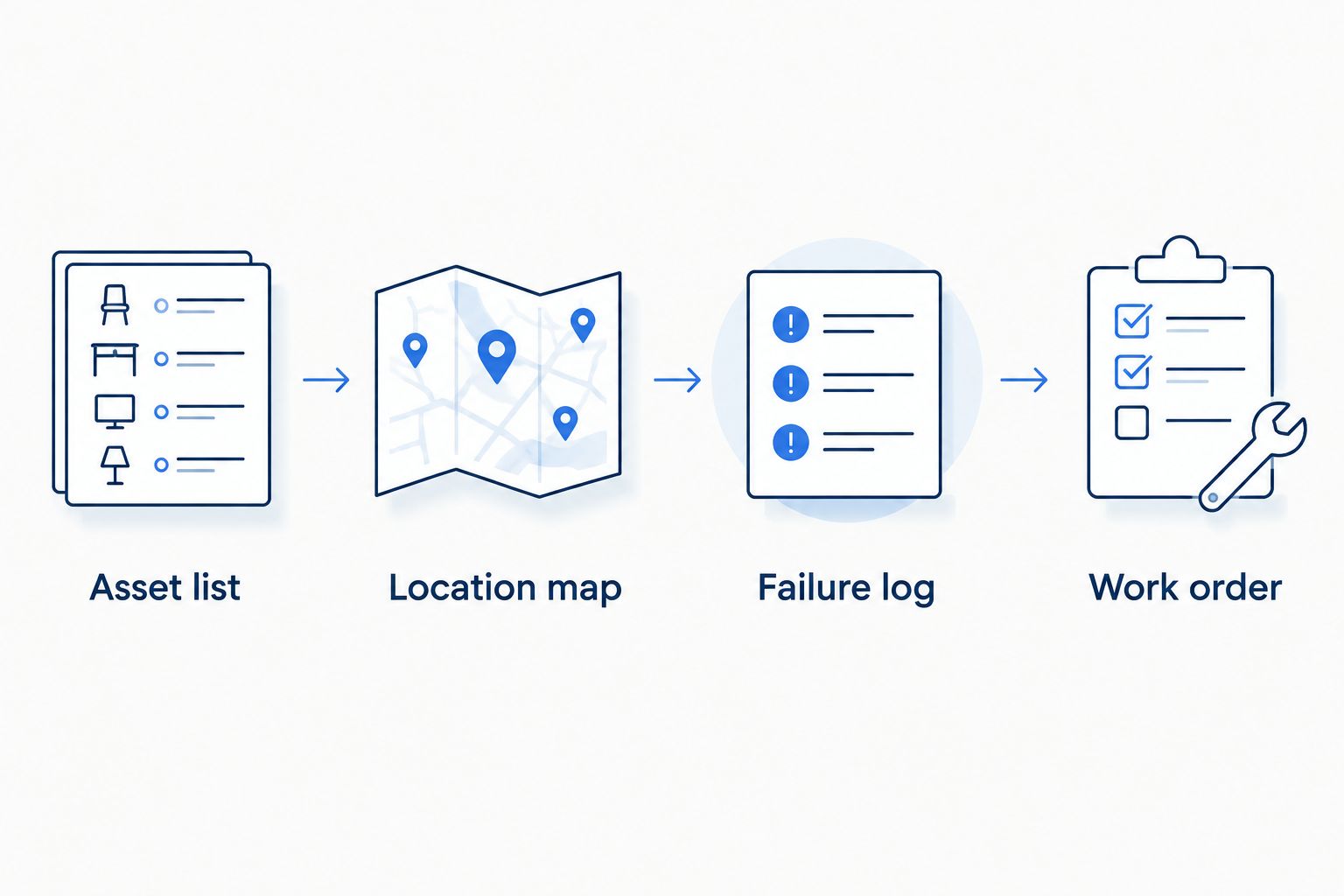
- Asset list: Record panels, disconnects, outlets, lighting, and fixed equipment.
- Location map: Identify each item by building, bay, or yard position.
- Failure log: Connect repeat problems to the affected asset.
- Work order: Assign responsibility and record repair status.
2. Set safe boundaries for staff inspections
Give drivers and shop staff a reporting checklist, not an electrical repair assignment. Staff can report a broken enclosure, damaged cord, dark fixture, or unusual smell without opening equipment. Make that boundary explicit during onboarding.
For your 2026 safety plan, OSHA’s electrical safe-work requirements in 29 CFR 1910.333 address work on or near electrical equipment. OSHA’s hazardous-energy standard, 29 CFR 1910.147, addresses covered servicing and maintenance activities. The applicable procedure depends on the task; switching equipment off is not proof that it is safe to service.
Have qualified personnel establish isolation procedures. A licensed electrician is needed for facility electrical diagnosis and repairs; electrical work also requires personnel qualified for the specific task.
- Keep staff out of open electrical enclosures.
- Report smoke, sparking, burning smells, and visible damage immediately.
- Keep people away from suspect equipment; follow your emergency procedure.
- Never repeatedly reset a breaker that trips.
- Have qualified personnel verify isolation before electrical work.
3. Get a documented baseline inspection
Gather old repair invoices, equipment manuals, and your failure log before scheduling an inspection. That gives the electrician a starting point without asking staff to perform tests. Include symptoms that disappear before anyone arrives, such as lights dimming when a compressor starts.
An on-site inspection establishes what needs repair, what needs further testing, and what belongs on a preventive schedule. Eagle Electric provides licensed commercial electrical contracting; ask for a written scope covering your shop and yard. A quote response is not an inspection or a confirmed repair appointment.
Do not request a blanket panel replacement before the problem is diagnosed. A panel labeled 200 amps does not, by itself, establish spare capacity or justify an upgrade. Connected loads and installation conditions need assessment.
- Supply the asset list and known fault history.
- Identify equipment additions and planned operational changes.
- Ask which findings require immediate action.
- Separate repair recommendations from optional improvements.
- Request written findings tied to equipment locations.
4. Match maintenance to equipment and exposure
Start with manufacturer instructions and existing service records. Build a calendar around the equipment you actually own, then have your electrician set the electrical inspection scope. Do not assign every asset the same interval because one annual reminder is easier to manage.
A dry office, a wash area, and an outdoor yard expose equipment to different conditions. Physical damage, moisture, corrosion, and repeated faults belong in the scheduling decision. Recheck the plan after a failure or a change in use.
Your 2026 calendar should identify who performs each task and what record proves completion. Staff observations, electrical testing, and equipment servicing are separate tasks. One checked box should not stand in for all three.
- Follow the applicable equipment maintenance instructions.
- Flag outdoor, wet, corrosive, and impact-prone locations.
- Assign inspections to personnel qualified for the task.
- Record findings, corrective work, and unresolved defects.
- Reassess intervals after damage, faults, or equipment changes.
5. Control shop loads and yard connections
List what runs together during a busy shift. Include compressors, welders, heaters, battery chargers, and block-heater connections where present. Give that operating pattern to the electrician rather than guessing capacity from unused breaker spaces.
Permanent equipment needs a suitable permanent electrical installation. Extension cords are not a substitute for fixed wiring. Where cords are permitted for a temporary task, their condition, rating, routing, and environment still matter.
Ask the electrician to assess circuit loading, grounding, receptacle condition, and required GFCI protection. A larger breaker is not a cure for repeated trips. The conductor, equipment, and circuit requirements must be checked before changes are made.
- Identify loads that operate at the same time.
- Report tripping circuits with the connected equipment listed.
- Keep cords out of vehicle paths and pinch points.
- Remove visibly damaged cords from service under site procedures.
- Have new equipment connections assessed before installation.
6. Plan outage work around dispatch and shop operations
Write down which functions must continue during a power interruption. Dispatch communications, selected lighting, doors, and shop equipment do not automatically need the same backup arrangement. Define the operating requirement before discussing generator size.
Start manually with a shutdown checklist and named contacts. For planned electrical work, identify affected circuits, equipment shutdown requirements, and the person authorized to approve the outage. Coordinate with the property owner and utility when the work requires their involvement.
For your 2026 outage plan, distinguish a quote response from the work schedule. Eagle Electric emphasizes same-business-day responses to quote requests and clear written quotes. That response does not promise same-day inspection, repair, or completion.
- Rank essential functions before selecting backup equipment.
- Confirm affected areas before an approved shutdown.
- Assign communication responsibility for dispatch and shop crews.
- Use approved transfer equipment for generator connections.
- Have qualified personnel assess restart and reconnection requirements.
7. Close every repair with a usable record
Keep one shared maintenance log rather than separate messages on drivers’ phones. A repair record should tell the next person what failed, what changed, and whether the equipment returned to service. An invoice alone does not always answer those questions.
Ask for clear written quotes that separate the problem, proposed work, exclusions, and required coordination. If inspection reveals additional damage, get the changed scope documented. Do not assume an initial quote includes unrelated circuits or concealed faults.
Close the work order only after the responsible person confirms the agreed work and records any remaining restrictions. Keep unresolved findings visible. A repair is not finished administratively while the same defect remains on another shift’s handwritten list.
- Record the asset and exact location.
- Attach the approved scope and repair documentation.
- Note testing or verification reported by qualified personnel.
- Update affected circuit labels and equipment records.
- Carry unresolved findings into the next work order.
Request a written electrical quote
Get a same-business-day response to your quote request. Inspection and work scheduling are separate.
Compare maintenance options for your trucking facility
Use staff reporting and qualified electrical service together. They handle different tasks. Staff know when a door stops working or a circuit trips; qualified electrical personnel determine the electrical cause and appropriate correction.
| Option | Best for | Main benefit | Key limitation |
|---|---|---|---|
| Staff visual reporting | Daily observations during normal operations | Captures damage and symptoms close to the event | Does not establish electrical safety or replace testing |
| Reactive electrical service | Diagnosing a reported failure | Focuses work on a specific fault | Does not create a facility-wide maintenance baseline |
| Planned electrical maintenance | Facilities needing documented inspections and follow-up | Connects inspection findings with scheduled corrective work | Requires access, records, and coordination around operations |
| Load assessment before expansion | Adding shop equipment or yard connections | Checks electrical requirements before installation | Does not replace ongoing maintenance |
Choose the scope around your facility, not a package name. A leased yard also needs a clear division between tenant duties and landlord responsibilities. Confirm that division before authorizing changes to the building’s electrical system.
Common electrical maintenance mistakes trucking companies make
Treating vehicle expertise as facility electrical qualification
A skilled diesel technician is not automatically qualified to troubleshoot building wiring. Separate truck and trailer repairs from premises electrical work. Assign each job to personnel qualified for that equipment and task.
Accepting repeated breaker trips as normal
A reset restores power without explaining the fault. Record what was running and stop repeated resets. Have a licensed electrician diagnose the circuit before adding equipment or changing protective devices.
Forgetting yard equipment in the maintenance scope
A shop-only inspection leaves exterior lighting, outdoor receptacles, and remote structures outside the record. Include every location your company controls. Mark inaccessible areas so they receive a separate inspection rather than disappearing from the list.
Buying backup power before defining essential loads
A generator decision starts with operating requirements, not the largest unit on a shortlist. Identify essential loads and have starting requirements, connections, and transfer arrangements assessed. Never connect a generator through an improvised building hookup.
Treating a quote response as a completion promise
A same-business-day response starts the conversation. It does not establish the fault, required materials, outage approval, or completion date. Confirm the inspection appointment, written scope, and work schedule separately.
FAQ
What does electrical maintenance for trucking companies include?
Electrical maintenance for trucking companies covers facility wiring, panels, equipment circuits, lighting, outlets, and related electrical systems. Truck batteries, alternators, and trailer wiring belong in a separate vehicle maintenance program.
How often should a trucking shop have electrical inspections?
Set inspection intervals from equipment instructions, site conditions, fault history, and a qualified assessment. There is no single interval that fits every shop, yard, and electrical asset.
Can our diesel mechanics repair the shop’s electrical wiring?
Diesel repair experience alone does not qualify someone to repair facility wiring. Use a licensed electrician and personnel qualified for the specific electrical task.
Does a tripping breaker mean we need a bigger panel?
A tripping breaker does not establish that you need a bigger panel. A licensed electrician must diagnose the circuit and assess loads, conductors, protection, and equipment before recommending changes.
Should block-heater outlets be included in yard maintenance?
Yes, include facility outlets and circuits used for block heaters in the electrical maintenance inventory. Have their condition, circuit loading, weather exposure, and required protection assessed.
Does Eagle Electric handle truck electrical repairs?
Eagle Electric’s stated services are residential, commercial, and oilfield electrical contracting in the Bakken region. Use a fleet repair provider for vehicle electrical work and request a facility electrical assessment for shop or yard systems.
Does a same-business-day quote response mean same-day repairs?
No. A same-business-day quote response is separate from an inspection appointment or repair schedule. Confirm the written scope, access requirements, and completion schedule before work begins.
One last thing
A breaker that stops tripping after equipment is unplugged has not been diagnosed. You have changed the operating condition, not proved the circuit is sound.
Make one practical change to your 2026 maintenance log: record what was running when each fault occurred. That detail gives the electrician a better starting point than a note that says only that power went out.


