

Yes. A small business can survive an extended power outage by protecting people, keeping essential equipment running safely, and having enough cash to cover a shutdown. Backup power does not solve every problem: lost sales, spoiled inventory, interrupted communications, and an unsafe building still need separate plans.
- Can a small business survive extended power outage disruption? Yes, with safe backup power and a workable shutdown plan.
- Eagle-Elc provides licensed commercial electrical contracting for businesses across the Bakken region.
- Size backup power around essential equipment, not just the building’s panel rating.
- Keep portable generators outdoors, at least 20 feet from doors, windows, and vents.
Can a small business survive an extended power outage?
Your business does not need every circuit running to survive. It needs a safe way to protect its essential operations and stop everything else. A business that can work remotely has different needs from a shop with refrigerated inventory or electrically powered production equipment.
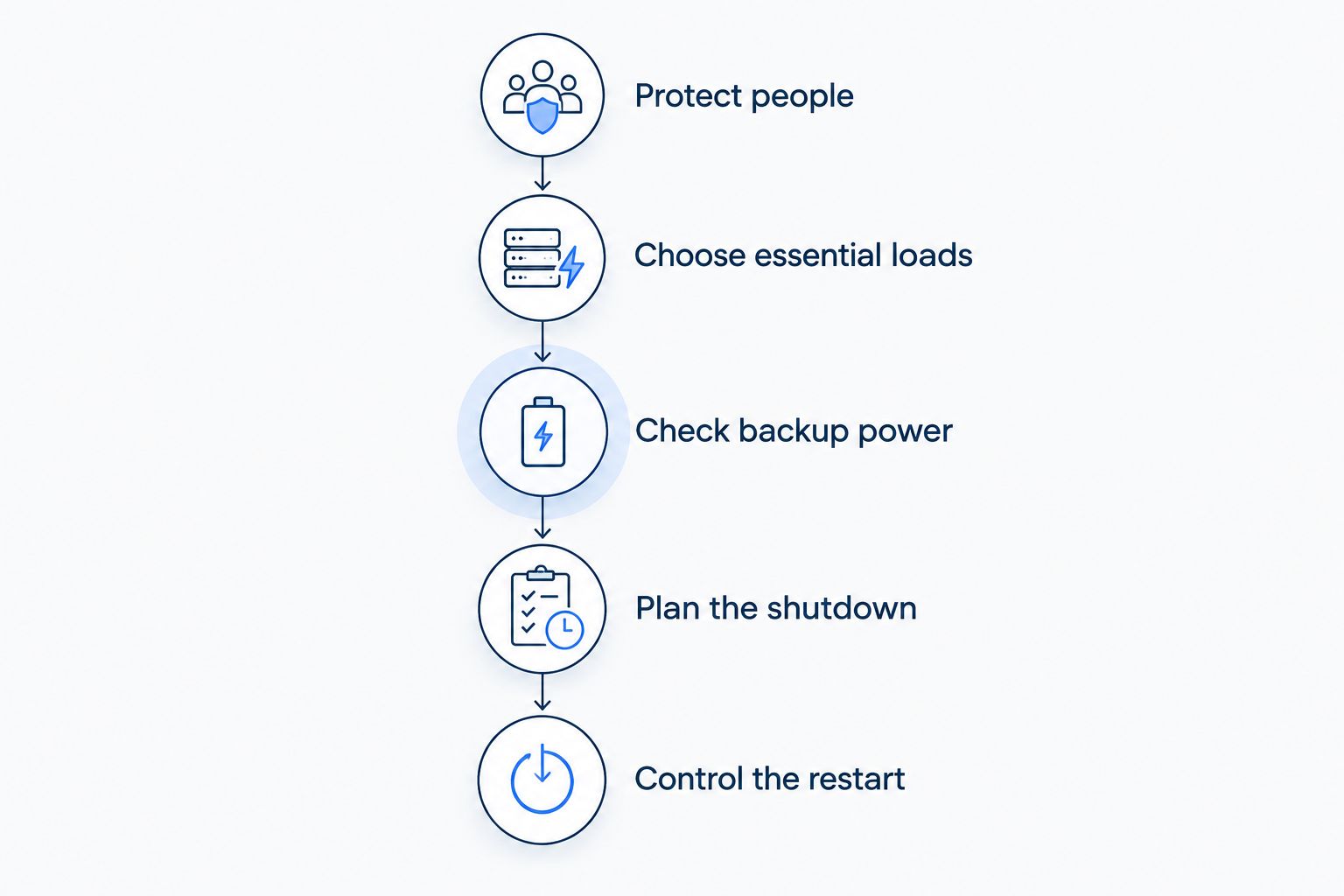
Start your 2026 outage plan with these steps:
- Protect people. Establish when employees must stop work or leave the building.
- Choose essential loads. List the equipment needed for safety, asset protection, and limited operations.
- Check backup power. Have a licensed electrician assess loads, connections, and transfer equipment.
- Plan the shutdown. Assign responsibility for inventory, customer notices, records, and security.
- Control the restart. Check conditions before equipment and employees return to normal work.
An on-site inspection is needed to determine what your existing electrical system can support. Eagle-Elc’s electrical services cover commercial electrical contracting across the Bakken region; the work needed at your building depends on its actual equipment and wiring.
Why this matters
An outage becomes a business problem before it becomes a generator problem. You still have employees to contact, customers waiting for answers, and obligations that do not disappear when the lights go out.
A generator also does not restore an internet provider, open a blocked delivery route, or make damaged equipment safe. Your 2026 continuity plan needs separate answers for electricity, staffing, communications, and cash.
Write down what forces a closure. Unsafe lighting, failed ventilation, unavailable sanitation, or a required safety system that no longer works are reasons to stop and assess conditions. Do not treat an illuminated checkout counter as proof that the building can remain open.
Choose backup power by the job it must do
Different backup arrangements solve different problems. Choose the operating mode first, then have an electrician determine the electrical requirements. None of these options replaces a shutdown procedure.
| Operating option | Best for | Main advantage | Main limitation |
|---|---|---|---|
| UPS battery backup | Keeping selected electronics running briefly or shutting them down safely | Bridges a brief interruption for connected equipment | Runtime depends on load and battery condition; it is not a general building-power solution |
| Portable generator | Selected compatible loads under a supervised operating plan | Can supply designated equipment during an outage | Requires safe outdoor placement, fuel handling, and an approved connection method |
| Permanently installed standby generator | Businesses needing backup for designated building circuits | Can supply selected circuits through properly designed transfer equipment | Needs site assessment, maintenance, fuel planning, and correct sizing |
| Controlled shutdown or remote work | Businesses able to pause on-site work | Avoids operating an unsafe or unsupported building | Does not protect equipment or inventory that still needs electricity |
UPS backup: protect the handoff
A UPS supplies battery power to connected equipment when utility power fails. For an office, that can give staff time to save work and shut down selected computers or network equipment properly.
Check the manufacturer’s runtime information at the actual connected load. A battery that supports a small router is not evidence that it can support a server and every workstation. Include battery condition and replacement requirements in your maintenance records.
Generator backup: protect selected operations
A generator needs enough capacity for the intended loads, including equipment starting requirements. Motors, compressors, and pumps deserve specific attention because their starting demand differs from normal running demand.
Do not select a generator from the service-panel label alone. A panel’s amp rating does not identify which equipment must run together or what happens when motors start. Have an electrician evaluate voltage, phase, load, transfer equipment, and the installation location.
Controlled shutdown: protect the business without staying open
Closing temporarily is a valid continuity decision. You can redirect calls, notify customers, secure records, and move suitable work off-site while the building remains closed.
The limitation is physical exposure. Remote work does not keep refrigeration running, protect a sump pump, or maintain building heat. Identify those needs separately before deciding that laptops and mobile phones are enough.
Why outage survival varies between businesses
There is no universal safe shutdown length. The consequences depend on what loses power and how quickly that loss creates an unsafe condition or damages an asset.
- Essential equipment. Refrigeration, pumps, heating controls, and production machinery create different backup requirements.
- Building conditions. Electrical damage, water intrusion, blocked exits, and failed ventilation affect whether anyone can work safely.
- Fuel and maintenance. Generator operation depends on the equipment’s instructions, fuel supply, and required service.
- Communications. A working computer is not enough if employees cannot reach customers or access required systems.
- Inventory exposure. Temperature-sensitive stock needs monitoring and a written handling decision, not an assumption that it stayed safe.
- Cash reserves. Rent, payroll obligations, and other bills need a plan while normal sales are interrupted.
Rank these exposures for your own operation. A written list of equipment and consequences is more useful to an electrician than a request to back up “the whole place.”
Keep generator operation separate from occupied space
Never run a portable generator inside a business, garage, shed, or other enclosed or partly enclosed space. Opening a door does not make indoor operation safe. Exhaust contains carbon monoxide, which can kill without warning.
CDC guidance places portable generators outdoors, at least 20 feet from doors, windows, and vents, with exhaust directed away from buildings. Follow the manufacturer’s instructions as well. If your site cannot provide safe placement, do not improvise a location beside an entrance or loading door.
Never power building wiring by plugging a generator into a wall receptacle. Backfeeding can energize wiring unexpectedly and endanger workers and other people. A licensed electrician must determine the approved transfer arrangement for your installation.
Keep employees out of panels and transfer equipment. Written operating instructions should identify authorized operators, safe shutdown procedures, and whom to call when equipment trips, smells hot, or behaves abnormally. A breaker that repeatedly trips needs investigation, not repeated resetting.
Protect refrigerated inventory with temperature records
For food businesses, elapsed time and measured temperature matter. The FDA’s power-outage guidance says an unopened refrigerator generally keeps food cold for about 4 hours. Refrigerated perishable food held above 40°F for 2 hours or more should be discarded.
Those are food-safety limits, not permission to keep a commercial kitchen operating without required systems. Follow applicable local health requirements and your business’s food-safety procedures. Never taste food to decide whether it is safe.
Keep refrigerator doors closed as much as possible. Record outage times and temperatures, and separate inventory requiring a disposal decision. Medicines and other temperature-sensitive products need their own manufacturer and regulatory instructions; food rules do not establish their safe storage limits.
For your 2026 plan, name the person authorized to discard unsafe stock. Staff should not have to choose between protecting customers and waiting for an unreachable manager.
Put the money and customer plan in writing
List the bills that continue during a closure and compare them with accessible cash. Then identify which collections, orders, and services can continue without the building. Use your own records rather than a generic estimate of daily outage losses.
Review insurance terms with your agent before an outage. Ask about covered causes, business interruption, spoilage, waiting periods, exclusions, and documentation. Do not assume a utility outage automatically creates a payable claim.
Give employees a contact method that does not depend entirely on office equipment. Assign someone to update customers, handle cancellations, and explain whether work is paused or moved. Keep an accessible copy of essential contacts outside the office network.
Save receipts, temperature logs, photographs, and a record of interrupted operations. Accurate records support decisions during the outage and any later discussion with an insurer.
Can I keep my business open with only partial power?
You can operate with partial power only when the remaining systems support safe, lawful work. Working receptacles do not establish that exits, alarms, ventilation, sanitation, and required equipment are adequate.
Set the limits before an outage. Identify which tasks remain permitted and who has authority to close the building when conditions change. An electrical inspection addresses electrical conditions; other operating requirements can also need review.
Can a generator run throughout a multi-day outage?
A generator can support a multi-day outage only within its manufacturer’s operating and maintenance requirements. Fuel capacity alone does not establish continuous runtime, and service or refueling can require shutdown.
Plan for those interruptions. Have a safe response for essential equipment while the generator is stopped, and never assume refueling a running or hot generator is acceptable.
Does utility power returning mean I can reopen?
Utility power returning does not prove the building is ready to reopen. Check for damage, unresolved equipment faults, unsafe inventory, and systems that failed to restart.
After water exposure, burning smells, damaged wiring, or abnormal electrical operation, keep affected equipment out of service until a qualified professional evaluates it. Bring loads back according to the approved restart procedure rather than switching everything on at once.
Get an electrical scope before choosing equipment
Bring an equipment list, operating priorities, and known electrical problems to the site assessment. Include anything that must restart automatically and anything that can remain off. That gives the electrician a defined job to evaluate.
Eagle-Elc is a fit for Bakken businesses that need licensed commercial electrical contracting. The backup arrangement still requires an on-site assessment; a general article cannot establish generator capacity, transfer compatibility, or whether existing wiring is suitable.
Request a clear written quote that identifies the agreed scope and any unresolved site conditions. Eagle-Elc emphasizes same-business-day responses to quote requests. A response is not a promise of same-day installation or completion.
Get your electrical scope in writing
Request a same-business-day response and a clear written quote for the agreed electrical work.
FAQ
Can my small business survive an extended power outage without a generator?
Yes, if your business can stop on-site work safely and protect essential assets without one. Remote work and customer communication do not replace power for refrigeration, pumps, or other critical equipment.
What should a business power first during an outage?
Prioritize systems needed for safety and asset protection, then the equipment required for limited operations. Have a licensed electrician assess the connected loads and the approved backup arrangement.
Is a battery backup enough for an extended business outage?
A battery backup is enough only when its verified capacity and runtime meet the connected equipment’s needs. A UPS used for orderly computer shutdown is not automatically suitable for refrigeration or building systems.
How far away should a portable generator be from my business?
Keep a portable generator outdoors at least 20 feet from doors, windows, and vents, following CDC guidance. Direct exhaust away from buildings and follow the manufacturer’s placement instructions.
How long does refrigerated food stay cold when power fails?
An unopened refrigerator generally keeps food cold for about 4 hours, according to FDA guidance. Use temperature records and applicable food-safety requirements to decide what must be discarded.
Can I connect a generator directly to a wall outlet?
No. Plugging a generator into a wall outlet can backfeed electrical wiring and create a deadly hazard. Have a licensed electrician determine the approved connection and transfer equipment.
Will business insurance cover losses from a power outage?
Coverage depends on your policy and the cause and circumstances of the outage. Ask your insurance agent about business interruption, spoilage, waiting periods, exclusions, and required records.
One last thing
Test the decision-making, not just the generator. For your 2026 outage review, ask the person opening the building what happens if utility power fails before the manager arrives.
That person should know when to stop work, whom to contact, and what not to touch. If the plan depends on someone guessing at the electrical panel, the plan is not ready.


