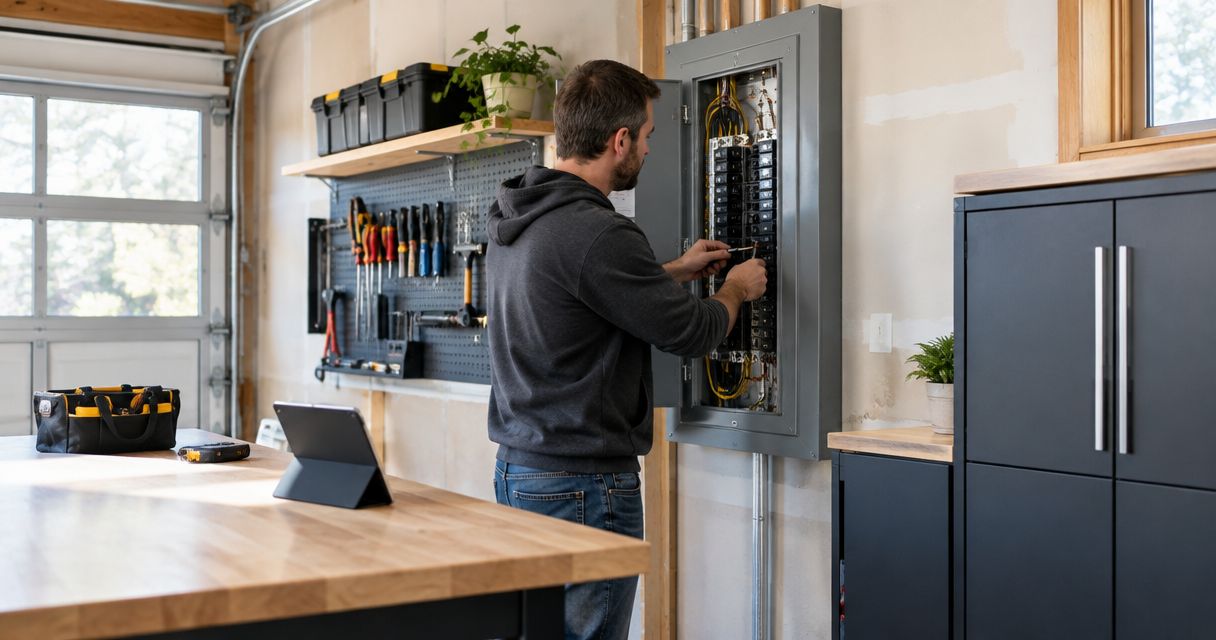
Best overall for a dry indoor workshop: a roomy main-lug subpanel. Best for a detached garage needing a local disconnect: a main-breaker subpanel. Best for an exposed location: an outdoor-rated subpanel. This 2026 guide compares panel configurations, not competing brands, so you can choose around your tools, building, and electrical service.
- The best subpanels for home workshops match calculated loads, circuit space, and installation conditions—not just amperage.
- A roomy main-lug subpanel is the default for a dry indoor workshop with an appropriate upstream disconnect.
- A main-breaker subpanel suits a detached garage when its breaker serves the required building disconnect.
- Eagle Electric provides residential electrical contracting for homeowners in Watford City and the Bakken region.
Why this matters
A table saw, dust collector, and electric heater do not create the same electrical demand as garage lighting. Adding breaker spaces does not add power to your home's service. A new subpanel redistributes the capacity available through its feeder.
Eagle Electric is a fit for homeowners who need licensed electrical contracting for a workshop subpanel in the Bakken region. Start with an on-site assessment through its electrical services, not a panel selected from a shelf.
For your 2026 workshop project, separate three decisions: the load you need to serve, the number of circuits you need, and the enclosure your location requires. Those decisions belong together. None replaces the others.
What makes the best subpanels for home workshops
Use these criteria before comparing configurations:
- Calculated load: Your electrician must account for equipment demand, simultaneous operation, and the existing service. Adding up breaker handles is not a load calculation.
- Usable breaker spaces: Leave room for planned circuits. A 240-volt circuit commonly uses a two-pole breaker occupying two full-size spaces.
- Correct disconnect arrangement: An attached workshop and a detached garage do not necessarily need the same disconnect layout.
- Suitable enclosure: A dry indoor wall and a location exposed to rain require different protection. The enclosure rating must match the actual conditions.
- Listed compatibility: Breakers, neutral bars, grounding bars, and accessories must be approved for the selected panel and installation.
- Practical installation: Feeder routing, working clearance, existing wiring, and future equipment affect the complete job—not just the box.
A good 2026 panel choice passes all six checks. A large amp rating printed on the label does not excuse a poor fit anywhere else.
Workshop subpanels at a glance
These configurations overlap. An outdoor-rated panel can also have a main breaker; this ranking assigns each option a distinct job rather than treating enclosure and disconnect choices as competing features.
| Rank and configuration | Best for | Standout feature | Key limitation |
|---|---|---|---|
| 1. Roomy indoor main-lug subpanel | Dry attached workshop with several planned circuits | Circuit expansion without an unnecessary local main breaker | Needs an appropriate upstream protection and disconnect arrangement |
| 2. Main-breaker subpanel | Detached garage needing a local disconnect | Local shutoff when properly selected and installed | Does not eliminate feeder, grounding, or service-capacity checks |
| 3. Outdoor-rated subpanel | Location exposed to weather | Enclosure selected for environmental exposure | Rain protection alone does not address every dust or corrosion condition |
| 4. Compact indoor subpanel | Small, dry workshop with limited circuit needs | Smaller enclosure footprint | Limited room for future circuits |
Match the configuration to the location first. Then have a licensed electrician select the feeder, panel rating, breakers, and protection requirements as one system.
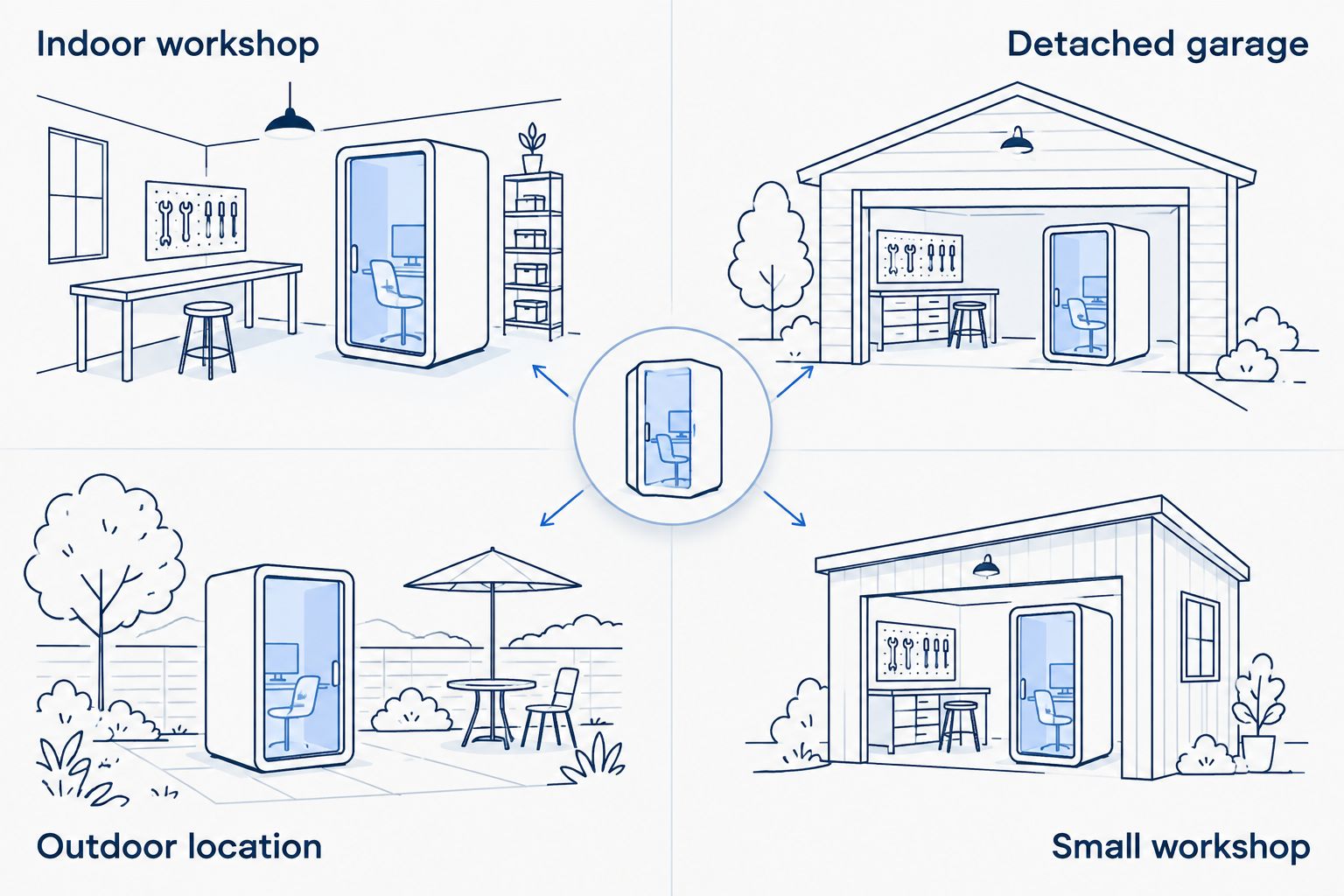
1. Roomy main-lug subpanel: best for an attached workshop
A main-lug subpanel receives its feeder conductors at lugs rather than through a main breaker inside that enclosure. For a dry attached workshop with suitable upstream protection and disconnecting means, it is a straightforward configuration. Choose circuit space around your equipment plan, not just today's empty wall.
Separate lighting and tool circuits deserve attention. A tripped tool circuit should not automatically leave you working beside a spinning machine in darkness.
Main-lug subpanel pros:
- Provides a central point for workshop branch circuits.
- Offers room for additional circuits when a larger enclosure is selected.
- Works with an appropriately designed upstream feeder breaker.
Main-lug subpanel cons:
- Does not provide a local main breaker within the panel.
- Extra spaces do not increase feeder capacity or household service capacity.
Ask your electrician to distinguish the panel's maximum rating from the feeder's protected rating. A panel rated for 100 amps does not deliver 100 amps when supplied through a correctly designed 60-amp feeder.
Best for: An attached, dry workshop with several circuits and a clear expansion plan.
Verdict: Buy this configuration after the load calculation and disconnect arrangement are confirmed.
2. Main-breaker subpanel: best for a detached garage
A main-breaker subpanel includes a breaker that disconnects the circuits supplied through it. In a detached garage, that breaker can serve as the building disconnect when the equipment and installation meet applicable requirements. Its presence alone does not make the installation compliant.
Detached-building work also needs a feeder and grounding plan. For a typical new feeder installation, the electrician separates the neutral and equipment-grounding paths at the subpanel and addresses the building's grounding-electrode requirements.
Main-breaker subpanel pros:
- Provides a local shutoff for supplied circuits.
- Fits a detached-building design that requires a building disconnect.
- Makes the disconnect location clear when properly labeled and accessible.
Main-breaker subpanel cons:
- The main breaker does not replace upstream feeder protection requirements.
- Grounding electrodes do not replace the feeder equipment-grounding conductor.
Discuss the trench route, underground utilities, building entry, and disconnect location before equipment selection. An existing detached-garage feeder needs inspection; do not assume an older installation supports new tools or heating equipment.
Best for: A detached garage where the selected main breaker will serve the required local disconnect.
Verdict: Buy this configuration when the detached-building design calls for it.
3. Outdoor-rated subpanel: best for an exposed location
An outdoor-rated subpanel uses an enclosure intended for its stated environmental conditions. A NEMA 3R enclosure, for example, provides protection against falling rain, sleet, and external ice formation. It is not a blanket solution for airborne dust, washdown, or corrosive exposure.
For a North Dakota installation in 2026, have the electrician check the equipment's published environmental limits and actual mounting conditions. Cold weather does not make an indoor enclosure suitable outdoors.
Outdoor-rated subpanel pros:
- Provides weather protection when the rating matches the exposure.
- Supports installation where a dry indoor location is unsuitable or unavailable.
- Can be selected with the disconnect arrangement the project requires.
Outdoor-rated subpanel cons:
- A rain-rated enclosure is not necessarily dust-tight.
- Poor fittings or improper installation can defeat the intended protection.
A garage also needs an exposure assessment. Wind-driven moisture, metal grinding dust, and routine washing are different problems. Ask which enclosure rating addresses your conditions instead of accepting “outdoor” as the whole specification.
Best for: An exterior wall or another location with environmental exposure requiring a rated enclosure.
Verdict: Buy the rating your location requires; skip an indoor-only box for outdoor use.
4. Compact indoor subpanel: best for a small workshop
A compact indoor subpanel fits a dry workshop with modest, clearly defined circuit needs. Its strongest case is a limited equipment plan and a suitable installation location—not an assumption that a small garage always needs little power.
A small room containing electric heat and substantial machinery can have significant demand. Conversely, a larger storage garage can have relatively limited electrical needs.
Compact indoor subpanel pros:
- Uses a smaller enclosure footprint.
- Organizes a limited set of dedicated circuits.
- Suits a stable equipment plan when capacity and spaces are adequate.
Compact indoor subpanel cons:
- Leaves less room for future branch circuits.
- Can become restrictive when additional two-pole breakers are needed.
Do not count on tandem breakers as an expansion plan. Their use depends on the panel's labeling, approved breaker types, and the protection required for each circuit.
Best for: A dry hobby workspace with a short equipment list and little planned expansion.
Verdict: Buy only after counting planned circuits; skip it when expansion is already likely.
Size the workshop before choosing the panel
Bring your electrician an equipment list, not a requested amp rating. For a 2026 project, include equipment you already own and specific additions you intend to make.
Use this checklist:
- Tool nameplates: Record voltage, current, and manufacturer requirements without removing covers or opening equipment.
- Simultaneous loads: Identify tools that run together, such as a saw and dust collector.
- Fixed equipment: Include electric heat, compressors, ventilation, and any planned vehicle charging.
- Existing service: Have the electrician assess the main panel, service capacity, and feeder connection.
- Feeder route: Identify the distance and route between the supply panel and workshop.
- Circuit plan: Separate lighting, receptacles, and equipment circuits as the design requires.
A 120/240-volt workshop feeder can support circuits of both voltages when properly designed. That does not establish its required amperage. Motors, heating loads, conductor sizing, voltage drop, and applicable code rules still need review.
GFCI requirements also belong in the design. A dedicated tool circuit is not automatically exempt because nuisance trips would be inconvenient.
Get a written scope before authorizing work
A clear written quote should identify the panel configuration, feeder work, planned circuits, grounding work, and permit or inspection responsibilities. It should also distinguish workshop work from any required service upgrade.
Eagle Electric emphasizes same-business-day responses to quote requests and clear written quotes. A response is not a promise of same-day job completion. Use the quote request to describe your building, equipment, and planned additions.
Ask what needs an on-site inspection before the scope can be finalized. Do not remove a panel cover to collect photographs or measurements.
Get your workshop scope in writing
Request a same-business-day response. Confirm the feeder, panel, and circuit scope before work starts.
How these configurations rank
This 2026 ranking follows installation fit, not brand popularity or claimed reliability. The roomy indoor main-lug configuration is the default for the defined attached-workshop use case. The other configurations address a local disconnect, environmental exposure, or limited circuit needs.
No single configuration wins every job. A detached garage exposed to weather can need both a main breaker and an outdoor-rated enclosure.
Which workshop subpanel should you choose?
Choose a roomy indoor main-lug subpanel for a dry attached workshop when the upstream protection and disconnect arrangement are appropriate. Choose a main-breaker configuration for a detached garage when it serves the required building disconnect. Add the enclosure rating the location requires.
If you cannot describe the equipment loads or existing feeder, hold the purchase. Eagle Electric provides workshop subpanel contracting within its residential electrical services; an on-site assessment establishes what your installation needs.
FAQ
What's the best subpanel for a home workshop?
A roomy indoor main-lug subpanel is a practical default for a dry attached workshop with suitable upstream protection and disconnecting means. A licensed electrician must confirm the load, feeder, circuit spaces, and installation conditions before selection.
Is a 60-amp or 100-amp subpanel better for a garage?
Neither rating is automatically better; the workshop load calculation determines the required feeder capacity. The panel rating, feeder rating, and existing household service must be evaluated separately.
Does a detached garage subpanel need a main breaker?
A detached garage needs a compliant building disconnect arrangement, but that does not always require a main breaker inside the subpanel. A main-breaker panel is one way to provide that disconnect when correctly selected and installed.
Can I use an indoor subpanel in an unheated garage?
An unheated garage does not automatically require an outdoor enclosure. The electrician must check moisture, exposure, equipment temperature limits, and the manufacturer's installation instructions.
Does a garage subpanel need separate neutrals and grounds?
A typical new feeder-supplied garage subpanel keeps the neutral isolated from the equipment-grounding system. Detached-building grounding electrodes do not replace the feeder equipment-grounding conductor.
Will adding a subpanel increase my home's electrical capacity?
No. A subpanel adds distribution points and circuit spaces, not utility service capacity. New workshop loads can require a service assessment or upgrade.
Can I install a workshop subpanel myself?
Use a licensed electrician for workshop subpanel assessment and installation. Feeder protection, disconnecting means, grounding, and permit requirements need professional review; do not open energized equipment to investigate.
One last thing
Count breaker spaces, not just tools. A future 240-volt machine commonly needs two full-size spaces, and lighting still needs its own circuit plan. Ask for both the load calculation and a circuit schedule before approving the panel.