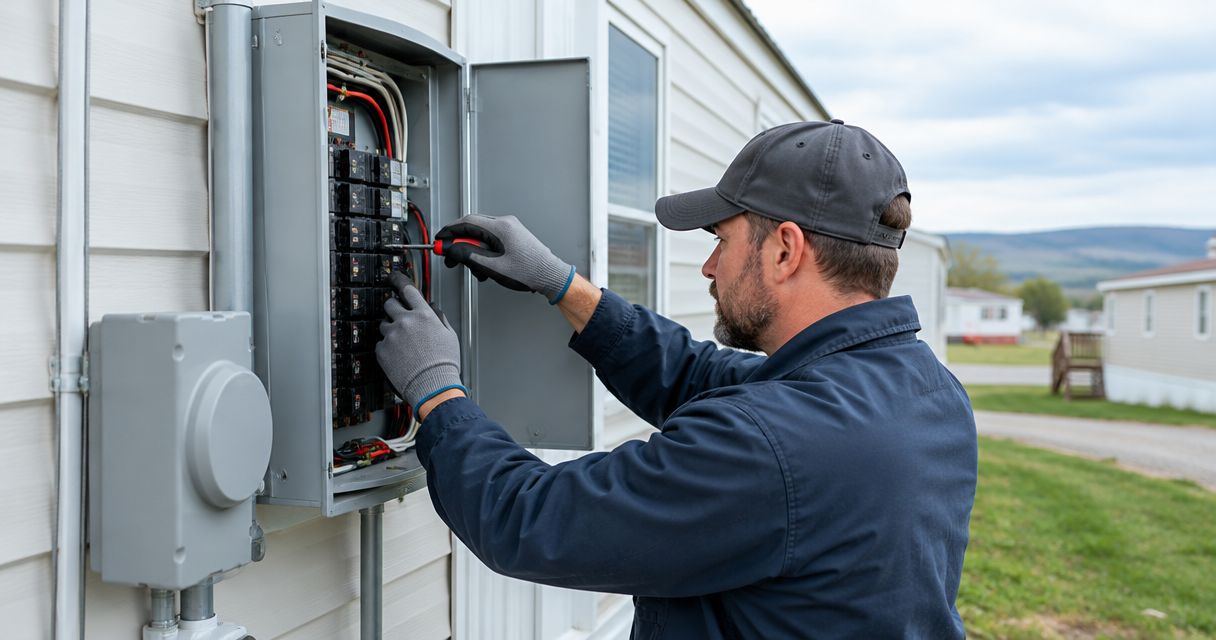
Best overall with an existing outdoor service disconnect: an indoor main-lug panel. Best for a local shutoff: an indoor main-breaker panel. Best when the outdoor service equipment needs replacement: a listed meter-main combination. The best electrical panels for mobile homes in North Dakota in 2026 match the home's service arrangement, calculated load, and installation conditions—not a brand ranking.
- The best electrical panels for mobile homes match the existing disconnect, feeder, and calculated electrical load.
- Choose an indoor main-lug panel when a suitable outdoor service disconnect already serves the home.
- Choose an indoor main-breaker panel when an accessible indoor shutoff belongs in the approved design.
- Choose an outdoor meter-main combination when the service entrance needs replacement, subject to utility approval.
- Eagle-Elc provides licensed residential electrical contracting across the Bakken region; panel selection requires an on-site inspection.
A breaker that keeps tripping needs a diagnosis, not a bigger breaker. Start with an inspection and a clear written quote. Eagle-Elc emphasizes same-business-day responses to quote requests, not same-day job completion.
Why this matters
A manufactured home can have an outdoor service disconnect and a separate indoor distribution panel. Those boxes do different jobs. Replacing the indoor panel does not automatically replace the outdoor disconnect, meter equipment, or feeder.
Eagle-Elc is best for Bakken homeowners who need licensed residential electrical contracting rather than a panel-only purchase. An on-site inspection establishes what equipment needs replacement and what can remain.
For a 2026 project, identify whether the structure is a manufactured home, modular home, or recreational vehicle. Do not apply a manufactured-home panel recommendation to an RV pedestal or temporary trailer hookup. The installation requirements are not interchangeable.
What makes the best electrical panels for mobile homes?
Use these criteria before selecting a cabinet or breaker family:
- Correct service role. Identify the service disconnect and determine whether the replacement panel sits downstream from it.
- Calculated capacity. Size the installation from the electrical load and equipment ratings, not the number of empty breaker spaces.
- Listed compatibility. Use breakers, accessories, and equipment combinations permitted by the panel's labeling and applicable listing.
- Suitable enclosure. Match indoor or outdoor equipment to its actual location and exposure.
- Usable circuit space. Allow room for existing circuits and identified additions without assuming every position accepts tandem breakers.
- Safe installation scope. Include grounding, bonding, feeder condition, required protection, permits, and inspection in the written scope.
A common residential supply is 120/240 volts. That voltage describes the supply arrangement; it does not tell you whether a 100-amp or 200-amp installation is appropriate. A licensed electrician must check the entire system.
Mobile-home panel options at a glance
These are installation configurations, not competing manufacturers. Each serves a different decision point.
| Panel configuration | Best for | Standout feature | Key limitation |
|---|---|---|---|
| Indoor main-lug panel | Replacing indoor distribution while retaining a suitable outdoor disconnect | Distributes power without adding an indoor main breaker | No single main breaker in the indoor cabinet |
| Indoor main-breaker panel | Adding a local indoor shutoff downstream from an outdoor disconnect | Provides an indoor disconnecting point | Does not replace the upstream service disconnect or increase service capacity |
| Outdoor meter-main combination | Replacing unsuitable outdoor service equipment | Combines metering provisions and a main disconnect in one listed assembly | Requires utility acceptance and does not replace indoor distribution by itself |
1. Indoor main-lug panel: best for indoor-only replacement
An indoor main-lug panel receives power from an upstream disconnect and distributes it to branch circuits. It is the default candidate when the outdoor service equipment and feeder are suitable, but the indoor panel needs replacement.
The electrician must verify upstream overcurrent protection and the panel's rating. The cabinet also needs enough usable space for the home's circuits and the breakers those circuits require.
Indoor main-lug panel pros
- Fits a design that already has a suitable external service disconnect.
- Keeps the replacement focused on indoor distribution when the rest of the installation is acceptable.
- Allows circuit organization and labeling within the replacement cabinet.
Indoor main-lug panel cons
- Does not provide a single indoor main breaker for shutting off the panel's branch circuits together.
- Does not correct a damaged feeder, unsuitable outdoor disconnect, or inadequate service capacity.
- Depends on verified upstream protection; cabinet size alone proves nothing.
Best for: A homeowner whose inspection supports replacing only the indoor distribution equipment.
Ask the electrician to identify the external disconnect and explain which equipment it de-energizes. An indoor panel replacement should not leave you guessing where the home's supply is controlled.
Verdict: Buy only after the outdoor disconnect, feeder, and panel rating are verified.
2. Indoor main-breaker panel: best for an indoor shutoff
An indoor main-breaker panel includes a main breaker in the cabinet. Downstream from an outdoor service disconnect, it can provide an additional local shutoff for the indoor panel's circuits when that arrangement fits the approved design.
That indoor breaker does not turn the cabinet into the service entrance. Grounding and bonding still depend on the equipment's actual position in the system.
Indoor main-breaker panel pros
- Provides a local way to disconnect the indoor branch circuits together.
- Gives occupants an identifiable indoor shutoff location.
- Can serve as downstream distribution equipment when properly selected and installed.
Indoor main-breaker panel cons
- Adds a main breaker that an otherwise suitable main-lug design does not require.
- Does not increase the feeder's allowable capacity.
- Does not make incoming terminals safe to touch when the upstream supply remains energized.
Best for: A homeowner who needs an indoor shutoff as part of the electrician's approved panel design.
A 200-amp cabinet does not turn a 100-amp supply into a 200-amp service. The upstream protection, feeder, service conductors, and other equipment still set limits. Read the related guide on upgrading to a 200-amp electrical panel before treating a cabinet rating as a capacity upgrade.
Verdict: Buy when the local shutoff solves a defined need; skip it as a shortcut to more capacity.
3. Outdoor meter-main: best for service-equipment replacement
A meter-main combination brings metering provisions and a main disconnect into one listed assembly. It belongs on the shortlist when the existing outdoor service equipment needs replacement, not merely because the indoor panel has crowded circuits.
Utility acceptance matters. The electrician must confirm the proposed equipment, mounting arrangement, service requirements, and connection process before purchase.
Outdoor meter-main pros
- Addresses the service entrance when that equipment is part of the problem.
- Groups metering provisions and a main disconnect within a listed assembly.
- Allows the service-equipment scope to be planned alongside feeder and indoor-panel work.
Outdoor meter-main cons
- Does not replace the indoor branch-circuit panel by itself.
- Requires coordination with the serving utility and applicable inspection authority.
- Needs an enclosure and installation suited to outdoor exposure and site conditions.
Best for: A homeowner replacing unsuitable, damaged, or otherwise deficient outdoor service equipment.
For a North Dakota project in 2026, have the electrician assess exposure, enclosure condition, mounting, and access. An outdoor-rated enclosure is not permission to ignore water entry, damaged fittings, or snow obstructing access.
Verdict: Buy only as part of a coordinated service-equipment replacement—not as an indoor-panel substitute.
Check the whole electrical path before buying
The panel is one part of the installation. A sound recommendation follows the power from the utility connection through the service equipment and feeder to the indoor circuits.
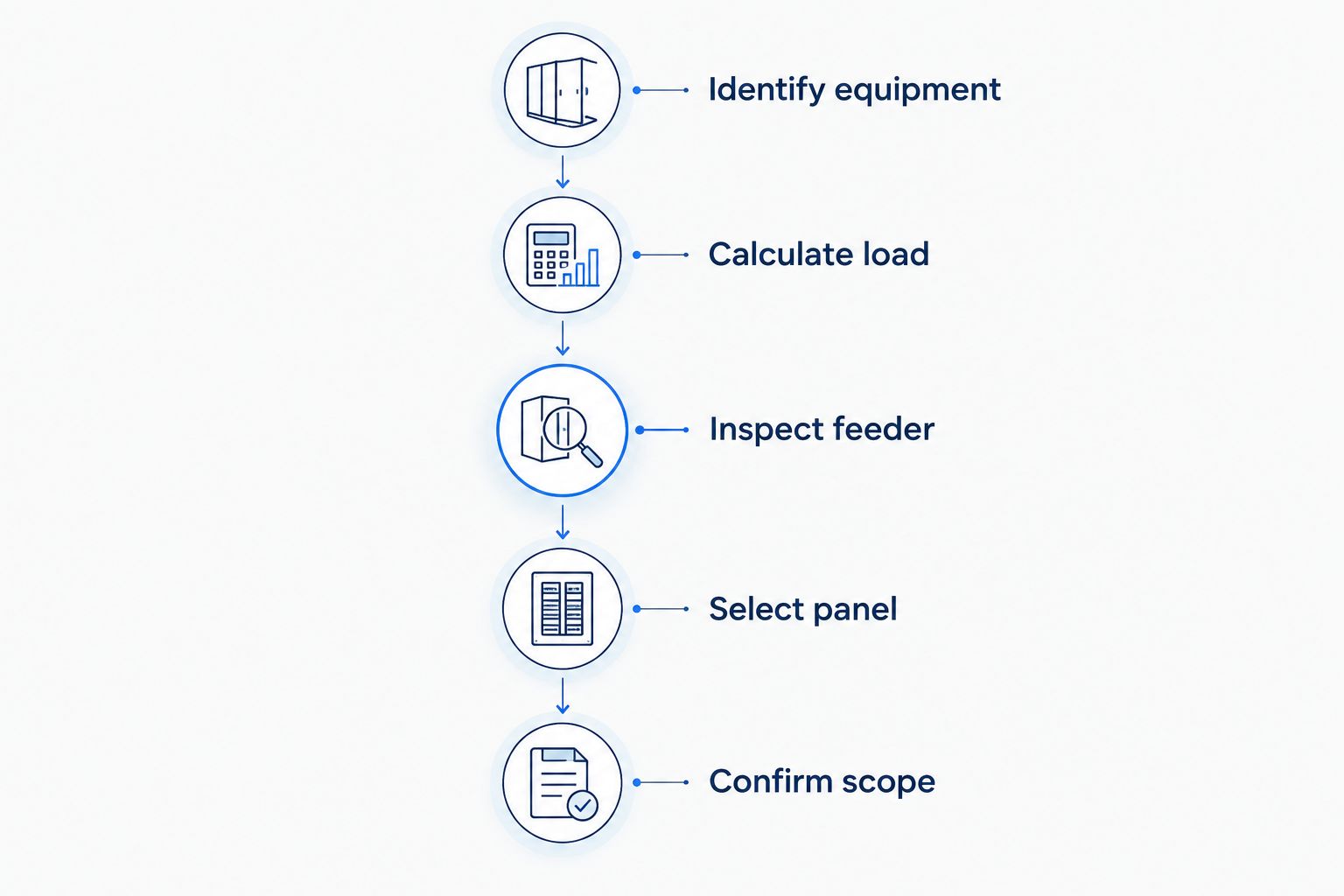
Use this inspection sequence for your 2026 replacement plan:
- Identify equipment. Locate the meter, service disconnect, indoor panel, and equipment labels.
- Calculate load. Account for existing appliances and planned additions, including electric heat or vehicle charging.
- Inspect feeder. Check conductor suitability, condition, protection, and grounding arrangements.
- Select panel. Match the cabinet, breakers, enclosure, and accessories to the approved design.
- Confirm scope. Set out utility coordination, permits, outage arrangements, inspection, and circuit labeling.
Keep homeowner preparation outside the cabinet. You can gather appliance information, describe symptoms, and provide access without removing the panel cover. Do not touch damaged electrical equipment or open a cabinet to photograph internal wiring.
Neutral and grounding arrangements need professional verification
A panel downstream from the service disconnect generally requires separation between the neutral and equipment-grounding functions. The correct arrangement depends on the complete installation and applicable requirements. This is not a homeowner wiring step.
The electrician must verify the feeder, cabinet bonding, grounding connections, and equipment instructions together. Copying the old panel's connections is not proof that the replacement is correct.
A tripping breaker is not a sizing instruction
A breaker can trip because of an overload, fault, damaged equipment, or another circuit problem. Installing a larger breaker without verifying conductor protection can create a fire hazard.
Report what was running when the trip occurred. If you notice smoke, arcing, or burning odors, keep away from the equipment and seek emergency assistance as appropriate. Do not keep resetting the breaker to see whether it holds.
What belongs in the written quote?
A useful 2026 panel quote names the work, not just the box. Eagle-Elc emphasizes clear written quotes so you can distinguish an indoor-panel replacement from a broader service upgrade.
Ask for these items:
- Equipment scope: Indoor panel, outdoor disconnect, meter-main, feeder, or a combination.
- Capacity basis: Calculated load and the ratings that support the proposed installation.
- Circuit work: Breaker compatibility, circuit identification, and required AFCI or GFCI protection.
- Grounding and bonding: Corrections included in the proposed work.
- Coordination: Responsibility for permits, utility arrangements, and inspection.
- Occupied-home plan: Expected power interruption and arrangements for critical electrical needs.
- Closeout: Panel directory, inspection requirements, and explanation of disconnect locations.
Ask what happens if the inspection reveals damaged conductors or other conditions outside the original scope. Get changes documented before authorizing additional work. A quote response is not a promise that the job will finish that day.
Request a written panel quote
Describe your panel problem and planned electrical additions. An on-site inspection determines the work.
How the panel configurations rank
The ranking puts the existing service arrangement first, then capacity, compatibility, enclosure suitability, circuit space, and installation scope. It does not rank manufacturers or claim results from product testing.
Indoor main-lug panels lead for a defined indoor-only replacement. Indoor main-breaker panels serve the separate need for a local shutoff. Meter-main combinations belong to service-equipment replacement. None is a universal winner.
Which mobile-home panel should you choose?
Choose the configuration that fixes the inspected problem without leaving upstream defects untouched. If the outdoor disconnect and feeder are suitable, start with an indoor distribution-panel assessment. If those components are deficient, expand the scope before selecting the cabinet.
For 2026, the best purchase decision is still an installation decision. Breaker space, an impressive amp rating, or a familiar label cannot replace a load calculation and on-site inspection.
FAQ
What's the best electrical panel for a mobile home in North Dakota?
The best electrical panel matches the home's service disconnect, feeder, calculated load, and installation conditions. An indoor main-lug panel is a candidate when suitable outdoor service equipment already provides the required upstream protection.
Does my mobile home need a 200-amp panel?
A mobile home needs a 200-amp installation only when the electrical design supports that capacity. A licensed electrician must calculate the load and verify the service equipment and conductors; the cabinet rating alone does not establish usable capacity.
Is a main-breaker panel better than a main-lug panel?
A main-breaker panel is better for providing a local indoor shutoff, but it is not automatically better for every installation. A main-lug panel can suit a home with an appropriate upstream disconnect and overcurrent protection.
Can I replace my mobile home's electrical panel myself?
Use a licensed electrician for mobile-home panel replacement. Turning off an indoor main breaker does not necessarily de-energize incoming conductors, and the job requires verification of grounding, bonding, protection, and applicable permit requirements.
Can I install a bigger breaker to stop repeated trips?
Do not install a bigger breaker to stop repeated trips without a licensed electrician's diagnosis. The breaker must protect the conductors and equipment it serves; increasing its rating can leave wiring improperly protected.
Does replacing the indoor panel also upgrade the electrical service?
Replacing the indoor panel does not automatically upgrade the electrical service. A capacity upgrade requires assessment of the utility supply, service equipment, feeder, protection, and calculated load.
What should I send when requesting a panel replacement quote?
Send a description of the problem, planned electrical additions, and safely accessible exterior equipment-label information. Do not remove covers or approach damaged equipment to gather details; an on-site inspection establishes the replacement scope.
One last thing
Empty breaker spaces are not spare electrical capacity. A panel can have room for another circuit while the feeder or calculated service load prevents adding it. Before buying equipment for electric heat, a workshop, or vehicle charging, have the electrician check both space and capacity.