Best overall: a commercial branch-circuit panelboard matched to your kitchen’s electrical service. Best for an addition: a feeder-supplied subpanel. Best for outage planning: a separate critical-loads panel. The best circuit breaker panels for restaurant kitchens solve a specific load, protection, or distribution problem—not just a shortage of breaker spaces.
- The best circuit breaker panels for restaurant kitchens match service voltage, calculated load, breaker protection, and installation conditions.
- Choose a commercial branch-circuit panelboard for a full kitchen renovation, subject to an electrical assessment.
- A subpanel adds circuit distribution, not electrical service capacity.
- Eagle Electric provides commercial electrical contracting for Bakken businesses; request an on-site assessment before selecting a panel.
Why this matters
A fryer trips during service. A replacement dishwasher needs a different circuit. The existing panel has open spaces, but nobody has checked the available capacity. These are different problems, and a bigger panel cabinet does not automatically fix them.
Eagle Electric is a licensed electrical contractor based in Watford City, serving businesses across the Bakken region. For a 2026 restaurant project, start with the equipment schedule and an on-site electrical inspection—not a panel ordered from a catalog.
The right panel fits the building, the kitchen equipment, and the required protection. Leave panel covers, voltage testing, and breaker work to a licensed electrician. If you notice smoke, arcing, or a burning smell, keep people away and contact emergency services when there is an immediate hazard.
What makes the best restaurant kitchen panel
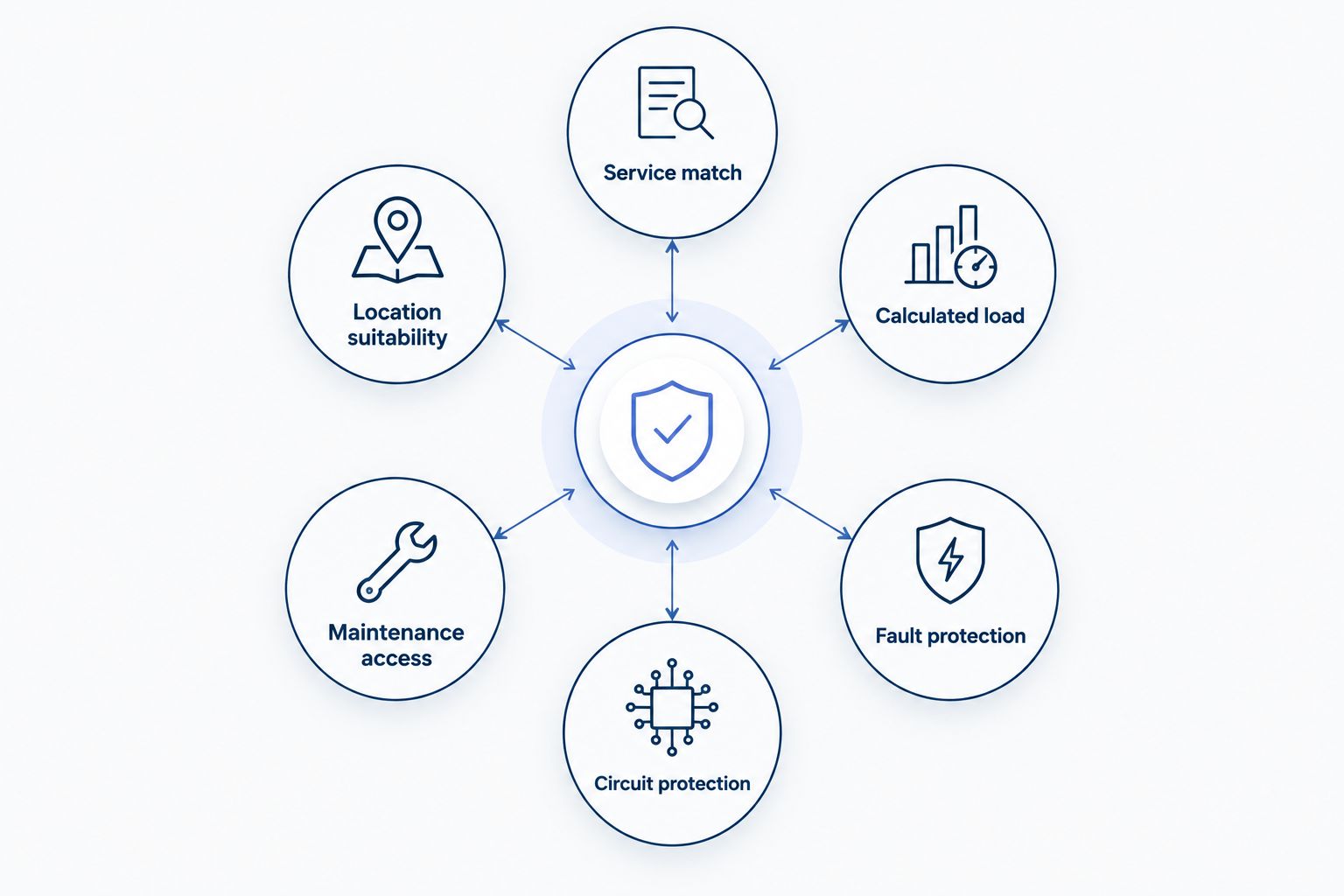
Use these criteria to compare configurations before discussing a particular enclosure or breaker family:
- Service match: The panel must match the supplied voltage, phase arrangement, and grounding system. Equipment nameplates determine what each appliance needs.
- Calculated load: Service and feeder capacity must support the calculated demand. Empty breaker spaces do not prove spare electrical capacity.
- Fault protection: The panel and breakers need ratings suitable for the available fault current. A breaker’s ampere rating alone does not establish that suitability.
- Circuit protection: Specify required GFCI protection and breakers identified for the panel. Physical fit does not establish compatibility.
- Location suitability: Account for moisture, cleaning practices, ambient conditions, and required working space. An enclosure rating does not excuse a poor location.
- Maintenance access: Require an accurate circuit directory, accessible disconnecting means, and a layout that supports future service work.
For 2026 planning, have the electrician confirm the North Dakota and local requirements applicable to your project. The National Electrical Code addresses working space, overcurrent protection, and panelboards in Articles 110, 240, and 408; the adopted edition and local requirements govern the installation.
Restaurant kitchen panels at a glance
These are installation configurations, not competing manufacturers. A restaurant can need more than one. Each recommendation addresses a different decision.
| Configuration | Best for | Standout feature | Key limitation |
|---|---|---|---|
| Commercial branch-circuit panelboard | Full kitchen renovation | Organizes kitchen circuits around a verified equipment schedule | Does not increase upstream service capacity |
| Feeder-supplied subpanel | A defined kitchen addition | Distributes circuits closer to added equipment | Depends on adequate feeder and upstream capacity |
| Separate critical-loads panel | Backup-power planning | Groups selected loads for a designed backup system | Requires transfer equipment and generator coordination |
| Environment-rated panelboard | An unavoidable damp or exposed location | Provides enclosure protection matched to documented conditions | Does not make every location acceptable |
1. Commercial branch-circuit panelboard: best for a full renovation
A commercial branch-circuit panelboard distributes power to the kitchen’s individual circuits. For a full renovation, it gives the electrician a defined place to organize equipment connections, receptacles, lighting, and required protective devices.
The equipment schedule comes first. A kitchen supplied by a 120/208 V three-phase system needs equipment and distribution selected for that system; a 120/240 V single-phase service is not interchangeable. A 120 V receptacle circuit also does not establish the voltage available for cooking equipment.
Commercial branch-circuit panelboard pros:
- Organizes circuits around the actual kitchen equipment list.
- Allows planned spare circuit positions for identified future equipment.
- Supports a clear circuit directory and equipment identification.
Commercial branch-circuit panelboard cons:
- A new panel does not correct an undersized service or feeder.
- Replacement requires a planned electrical shutdown and inspection coordination.
Best for: A restaurant rebuilding the kitchen layout, replacing several major appliances, or correcting an inadequate distribution arrangement.
Specify the proposed panel rating, breaker schedule, enclosure, and any upstream work in the written scope. Do not accept a proposal that names only the cabinet while leaving the feeder, grounding, or required protection unresolved.
Verdict: Buy this configuration for a full renovation only after the load calculation and service assessment support it.
2. Feeder-supplied subpanel: best for a kitchen addition
A feeder-supplied subpanel distributes circuits from an upstream electrical source. It suits a defined addition, such as a new prep area, when the existing electrical system has verified capacity to serve it.
The distinction matters: a subpanel provides distribution space, not new utility capacity. Adding breaker positions cannot make an overloaded feeder acceptable or turn a limited service into a larger one.
Feeder-supplied subpanel pros:
- Groups circuits serving the added kitchen area.
- Places distribution closer to the equipment when the location is suitable.
- Separates the addition’s circuit directory from unrelated building loads.
Feeder-supplied subpanel cons:
- Feeder sizing and upstream protection constrain the added load.
- Another enclosure needs compliant working space and maintenance access.
Best for: A restaurant adding a specific equipment area while keeping a suitable existing main distribution system.
Ask the electrician to document the feeder capacity and proposed connected loads. The installation also needs the correct neutral and grounding arrangement; do not treat a subpanel as a small main panel with identical connections.
For a 2026 expansion, list the next planned appliance before the feeder is designed. “Room for growth” should refer to identified loads and available capacity, not just unused knockouts.
Verdict: Buy a feeder-supplied subpanel for a defined addition when the upstream system passes the capacity check.
3. Separate critical-loads panel: best for backup-power planning
A separate critical-loads panel groups circuits selected for a backup-power system. That selection starts with an operating plan: what must remain powered, what can stay off, and what equipment must operate together.
Refrigeration, controls, and selected lighting are candidates for assessment, not automatic inclusions. Motor starting requirements, generator capacity, required safety systems, and transfer arrangements determine the final design.
Separate critical-loads panel pros:
- Makes the selected backup loads explicit.
- Separates backed-up circuits from equipment outside the backup plan.
- Supports clearer documentation for outage operation and maintenance.
Separate critical-loads panel cons:
- A panel alone provides no backup power.
- Existing circuits can require rerouting or redesign to support the separation.
Best for: A restaurant planning generator-backed operation with a defined list of essential loads.
Keep optional business-continuity loads distinct from legally required emergency or standby systems. The electrician must identify the applicable requirements rather than assume one panel or transfer switch serves every purpose.
Do not size the arrangement from the sum of breaker handles. Equipment demand, starting characteristics, and operating priorities matter. Transfer equipment must prevent an unsafe connection between utility and generator sources.
Verdict: Hold the panel purchase until the backup-load list, generator requirements, and transfer design are settled.
4. Environment-rated panelboard: best for unavoidable exposure
An environment-rated panelboard uses an enclosure selected for the conditions at its installation point. It becomes relevant when a suitable dry indoor location is unavailable and the proposed location involves moisture, outdoor exposure, or other documented conditions.
Start by asking whether the panel can be relocated away from the exposure. An enclosure rating is not permission to place electrical equipment where cleaning practices, corrosion, or blocked access make the installation unsuitable.
Environment-rated panelboard pros:
- Matches enclosure protection to identified site conditions.
- Makes exposure requirements part of the equipment specification.
- Supports a location-specific design rather than a generic indoor selection.
Environment-rated panelboard cons:
- An outdoor rating does not automatically establish washdown suitability.
- Fittings, entries, and maintenance practices must preserve the required protection.
Best for: A restaurant with an unavoidable exposed distribution location that a licensed electrician has assessed.
For a 2026 North Dakota project, check the proposed equipment’s published operating conditions when cold exposure is involved. Do not assume that an outdoor enclosure rating answers every temperature question.
Keep required working space clear. A panel behind stored supplies, kitchen equipment, or a locked-in-place fixture is not a practical maintenance arrangement merely because its door can open.
Verdict: Buy an environment-rated configuration only after confirming that the location itself is acceptable.
What your electrician needs before specifying a panel
Give the electrician a current equipment list, not just a photograph of the existing panel. Include nameplate photographs taken without removing electrical covers, installation instructions, and any planned equipment changes.
Organize the job around these steps:
- Record the equipment. Identify cooking appliances, refrigeration, dishwashing, ventilation, and other connected loads. Include equipment being removed.
- Inspect the supply. Have the electrician verify service characteristics, panel condition, feeder capacity, and the existing distribution arrangement.
- Check protection. Establish required circuit protection, equipment compatibility, and suitable fault-current ratings.
- Plan the shutdown. Coordinate access, refrigeration needs, inspections, and restaurant operations before setting the work date.
- Define the handover. Require circuit identification and documentation of the completed scope.
Do not replace a repeatedly tripping breaker with a larger one to keep service moving. A trip needs diagnosis. The cause can involve the appliance, wiring, connections, protective device, or load—not simply an undersized breaker.
Eagle Electric provides commercial electrical services for Bakken businesses. Request a same-business-day response to your quote inquiry and a clear written quote that identifies the proposed work. A quote response is not a promise of same-day job completion.
Request a kitchen electrical quote
Ask for a same-business-day response and a clear written scope for your kitchen panel project.
How these configurations were ranked
The ranking follows the installation problem: full renovation, limited addition, backup-power separation, or unavoidable exposure. Service match, calculated load, protection, location, and maintenance access determine suitability.
This is not a manufacturer reliability ranking or a claim of hands-on product testing. For 2026 purchasing, an approved installation design matters more than a generic product leaderboard.
Which restaurant kitchen panel should you choose?
Choose a commercial branch-circuit panelboard as the starting configuration for a full kitchen renovation. Choose a feeder-supplied subpanel for a defined addition only when the existing system can support it. Resolve backup operation and environmental exposure as separate design requirements.
Eagle Electric is a fit for Bakken restaurant owners who need licensed commercial electrical contracting. The next move is an on-site assessment and a written scope—not buying a panel before the electrical requirements are known.
FAQ
What are the best circuit breaker panels for restaurant kitchens?
The best circuit breaker panels for restaurant kitchens match the electrical service, calculated loads, required protection, and installation conditions. A commercial branch-circuit panelboard is the starting configuration for a full renovation, subject to an on-site assessment.
Does adding a subpanel give my restaurant more power?
No. A subpanel adds circuit distribution, not electrical service capacity. A licensed electrician must verify that the service and feeder can support the added equipment.
Can I stop a kitchen breaker from tripping by installing a bigger breaker?
Do not install a larger breaker to stop repeated trips. A licensed electrician must diagnose the cause and verify conductor, equipment, and circuit-protection requirements before making changes.
Do restaurant kitchen circuits need GFCI protection?
Commercial kitchen installations have GFCI requirements under applicable electrical codes. The electrician must check the adopted code, circuit characteristics, and equipment connections to determine the protection required for your project.
Can a restaurant panel go near a dishwashing area?
The proposed location requires an on-site assessment of moisture exposure, cleaning practices, equipment suitability, and working space. An enclosure rating alone does not establish that the location is acceptable.
Can one panel handle both utility and generator power?
A properly designed system can supply selected circuits from utility or generator power through suitable transfer equipment. A panel alone cannot transfer sources or prevent unsafe backfeeding.
Will Eagle Electric finish a panel replacement the same day?
Same-day job completion is not promised. Request a same-business-day response to your quote inquiry; the installation schedule depends on the assessed scope and required coordination.
One last thing
Spare breaker spaces are not spare power. Photograph the equipment nameplates and list the next planned appliance before requesting a panel quote. That information is more useful than a request for “the biggest panel that fits.”