
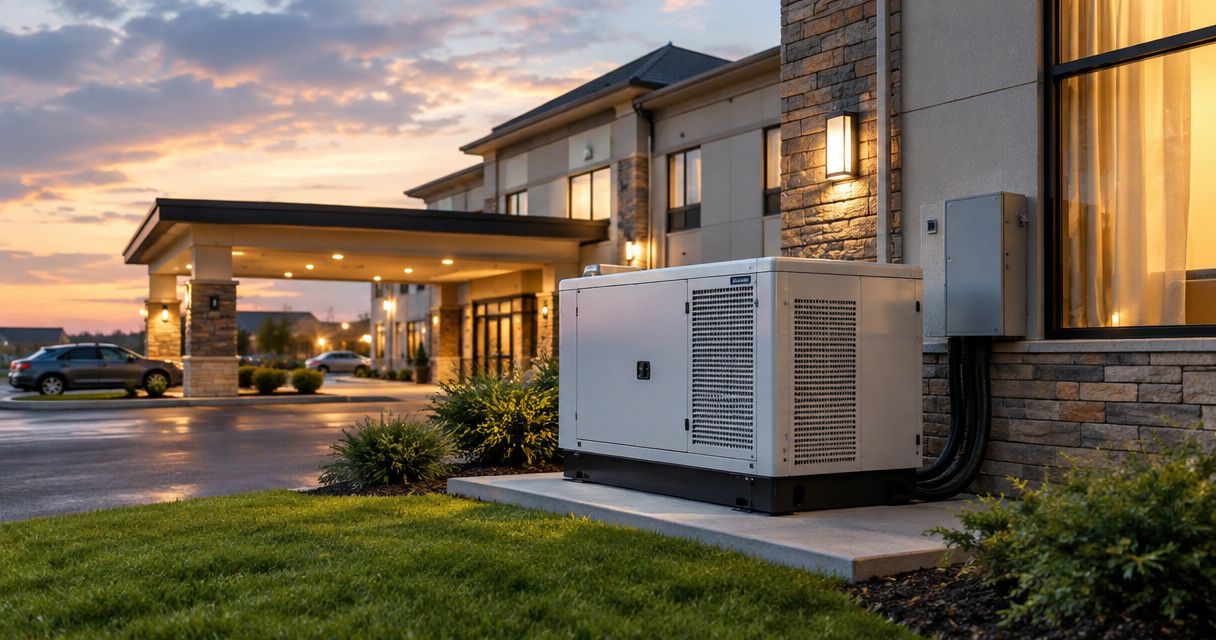
Best overall: automatic standby power for essential hotel loads. Best for full-property operation: a whole-building standby system. Best for uninterrupted front-desk electronics: standby power paired with a UPS. This 2026 guide compares the best backup power systems for hotels and motels by what each system keeps running, what it leaves out, and what your electrician must verify.
- The best backup power systems for hotels and motels start with automatic standby power for essential loads.
- Whole-building standby suits properties that need broader operation, but requires a building-specific load calculation.
- A UPS bridges generator startup for selected electronics; it does not replace sustained backup power.
- Eagle Electric provides licensed commercial electrical contracting in the Bakken region.
Why this matters
A generator that keeps hallway lights on does not necessarily keep guest rooms warm. Heating equipment, pumps, controls, communications, and required safety systems have different electrical needs. Your backup plan must name the circuits that stay powered and the operations that stop.
Eagle Electric provides licensed commercial electrical contracting from Watford City across the Bakken region. Eagle Electric is a fit for Bakken hotel owners who need licensed commercial electrical contracting.
For your 2026 project, separate required emergency functions from guest-comfort loads before choosing equipment. The applicable code, local authority, building layout, and existing electrical system determine how those functions must be supplied. An on-site inspection comes before a final system recommendation.
What makes the best hotel backup power system
Judge the system against these criteria, not the generator enclosure or a nameplate alone:
- Load coverage: Identify heating controls, circulation pumps, refrigeration, communications, lighting, and other equipment you intend to support.
- Transfer method: Decide which loads require automatic transfer and which can tolerate a controlled manual response.
- Starting capacity: Account for motor starting and staged equipment restart, not just normal running demand.
- Fuel and winter readiness: Review fuel arrangements, manufacturer temperature limits, starting provisions, and access for maintenance.
- Electrical compatibility: Match the building's voltage, phase, distribution equipment, and protection requirements.
- Maintainability: Require safe service access, a testing plan, and clear operating responsibilities.
The best system is the one that powers a written operating plan—not an undefined promise to keep the hotel open.
Hotel backup power systems at a glance
These are system configurations, not competing equipment brands. The order reflects a practical decision path for an occupied property.
| Rank | System | Best for | Standout feature | Key limitation |
|---|---|---|---|---|
| 1 | Essential-load automatic standby | Keeping core operations powered | Automatic transfer to selected loads | Excludes circuits outside its scope |
| 2 | Whole-building standby | Broad property operation | Supports a wider operating plan | Larger electrical and fuel scope |
| 3 | Standby plus UPS | Front-desk and network continuity | Bridges the generator-start interval | UPS capacity covers selected equipment only |
| 4 | Battery energy storage | Short-duration, quiet backup | No engine exhaust during battery discharge | Stored energy limits duration |
| 5 | Portable generator with approved connection | Controlled temporary support | Movable power source | Requires manual deployment and safe outdoor placement |
1. Essential-load standby: best for core hotel operations
An essential-load standby system automatically supplies selected circuits when utility power fails. The electrician defines those circuits through the distribution and transfer arrangement. This keeps the project focused on what your property must operate during an outage.
That list needs detail. A heating system can depend on electrical controls, blowers, or circulation pumps even when electricity is not its primary heat source. Powering a thermostat alone does not establish that the heating system will work.
Essential-load standby pros:
- Supports an agreed list of operating priorities.
- Transfers selected loads without waiting for staff to connect equipment.
- Allows discretionary loads to remain outside the backup scope.
Essential-load standby cons:
- Unselected guest-room circuits remain without backup power.
- Existing circuit layouts can require distribution changes.
- Automatic transfer still includes an interruption while the generator starts.
Best for: Owners who need a defined outage operating mode rather than unrestricted building operation.
For a 2026 installation, ask for a circuit schedule showing exactly what receives backup power. Include exclusions in the written quote. “Essential loads” is not a complete scope by itself.
Verdict: Buy this configuration when a documented essential-load plan meets your property's needs.
2. Whole-building standby: best for broad property operation
Whole-building standby supports a wider set of building loads through an engineered generation and transfer arrangement. The design must address simultaneous demand, motor starting, and any automatic load management. A whole-building label does not prove that every appliance can run together.
Start with your operating goal. Keeping occupied rooms functional is different from running guest-room heating, laundry, kitchen equipment, and every other amenity without restrictions. The load calculation must reflect that distinction.
Whole-building standby pros:
- Covers more of the property's electrical distribution.
- Reduces the number of functions intentionally excluded from backup.
- Supports a broader guest-service plan when properly sized.
Whole-building standby cons:
- Expands generation, transfer, and fuel requirements.
- Requires careful coordination of large starting loads.
- Still needs separate treatment of loads subject to specific emergency-power requirements.
Best for: Properties whose outage plan depends on broad building operation rather than a limited set of circuits.
Do not size this system from room count or the main breaker rating alone. A licensed electrician must inspect the service and equipment; engineering review is needed where the project requires it.
Verdict: Buy only when the broader operating requirement is clear and the design supports it.
3. Standby plus UPS: best for front-desk continuity
A standby generator takes time to start and transfer the load. An appropriately selected uninterruptible power supply, or UPS, supplies connected equipment during that interval. The combination addresses both the initial interruption and a longer outage.
This configuration suits selected computers, network equipment, and communications devices. Keeping local equipment powered does not guarantee that an outside internet connection, booking platform, or telephone service remains operational.
Standby plus UPS pros:
- Bridges the generator-start interval for connected equipment.
- Helps selected electronics avoid an immediate shutdown.
- Separates short-term continuity from sustained generator operation.
Standby plus UPS cons:
- UPS batteries need inspection and eventual replacement.
- Connected load determines backup duration.
- Generator and UPS compatibility must be checked.
Best for: Hotels that need selected front-desk and network equipment to remain powered through transfer.
Identify the complete equipment chain. A powered front-desk computer is not enough if its network switch loses power. Have the electrical contractor and your technology provider agree on the supported devices before equipment selection.
Verdict: Buy as an addition to standby power when a brief interruption would disrupt essential electronics.
4. Battery energy storage: best for short, quiet backup
A properly designed battery energy storage system supplies selected loads from stored electrical energy. Unlike an engine generator, the battery produces no engine exhaust while discharging. Backup operation requires equipment and controls designed to isolate the building from the utility supply.
Battery capacity and output are separate limits. Kilowatts, or kW, describe power output; kilowatt-hours, or kWh, describe stored energy. Both must fit your load plan.
Battery energy storage pros:
- Supplies power without an operating combustion engine.
- Supports selected loads where limited-duration backup meets the need.
- Can be designed around a clearly defined critical-load group.
Battery energy storage cons:
- Stored energy runs down unless a suitable charging source is operating.
- Large heating loads can consume stored energy quickly.
- Installation requires review of siting, temperature limits, and applicable safety requirements.
Best for: Properties with a limited load list and a defined short-duration backup objective.
For illustration only, 10 kWh of usable stored energy divided by a steady 2 kW load equals 5 hours before accounting for conversion losses and operating limits. That is arithmetic, not a runtime promise for your hotel. Your 2026 design must use actual equipment specifications and measured or calculated loads.
Verdict: Hold until a load-and-duration calculation proves battery-only backup meets your operating plan.
5. Portable generator: best for controlled temporary support
A portable generator can support selected equipment through a properly designed temporary-power arrangement. Supplying building wiring requires approved transfer equipment and installation by a licensed electrician. A cord connected to an ordinary receptacle is not a building backup system.
Never run an engine generator inside a building, garage, or other enclosed space. Carbon monoxide can kill. Outdoor placement must also address exhaust exposure at windows, doors, and ventilation intakes, following manufacturer instructions and applicable requirements.
Portable generator pros:
- Provides a movable source for a defined temporary need.
- Supports selected loads through an approved connection arrangement.
- Fits a controlled contingency plan with trained operators.
Portable generator cons:
- Requires staff to deploy and operate it safely.
- Manual startup leaves loads without power until the response is complete.
- Exhaust, fuel handling, weather, and access complicate operation.
Best for: Planned temporary support with a licensed connection design and assigned operating staff.
Do not make a portable unit your default plan for required hotel emergency systems. Those systems need a code-specific design, not an improvised response during an outage.
Verdict: Skip as the default hotel solution; use only for a defined, professionally reviewed temporary role.
Turn the ranking into a written scope
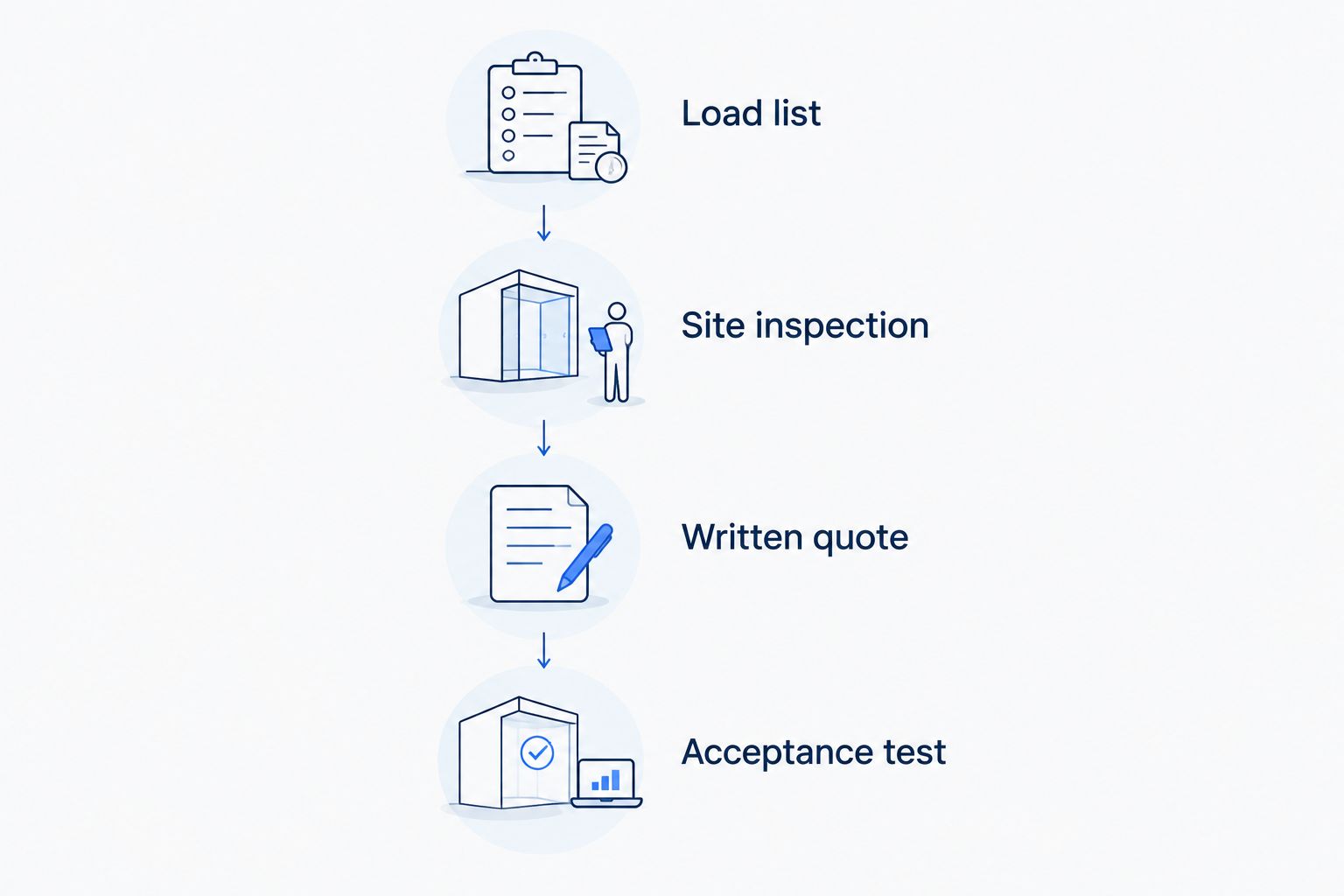
The equipment decision comes after the operating decision. Use this sequence to keep a 2026 quote tied to the building rather than a generic generator package.
Load list
Write down what must run and what can stop. Include equipment dependencies: heating controls and pumps, access systems and their supporting equipment, refrigeration, and communications. Separate required safety functions for professional review.
Site inspection
Have a licensed electrician inspect the service, panels, proposed equipment location, and connection route. Confirm voltage and phase from the actual installation. Identify fuel coordination, utility coordination, permits, and engineering requirements before treating the scope as final.
Written quote
Require equipment scope, transfer arrangements, included circuits, exclusions, site work, and commissioning responsibilities in writing. Eagle Electric emphasizes same-business-day responses to quote requests and clear written quotes. A quote response is not a promise of same-day installation or job completion.
Acceptance test
Require a planned outage simulation and load verification under safe, controlled conditions. Confirm the transfer sequence, supported equipment, alarm indications, and return to utility power. Get operating instructions and maintenance responsibilities documented before handover.
Put the circuit list beside the quote when reviewing proposals. If an item appears in your outage plan but not in the electrical scope, resolve the gap before approving the work. You can request a written quote with your property address, existing equipment details, and priority loads.
Define your backup power scope
Ask for a same-business-day quote response and a clear written scope for your property.
How these systems rank
Essential-load automatic standby ranks first because it directly connects backup equipment to a defined operating plan. Whole-building standby serves a broader requirement. Standby plus UPS addresses interruption-sensitive electronics, while batteries and portable generators serve narrower operating needs.
The ranking uses load coverage, transfer method, starting capacity, winter readiness, compatibility, and maintainability. It is a configuration guide—not a claim that specific equipment has been tested at your property.
Which backup power system should you choose?
Start with essential-load automatic standby and a licensed on-site assessment. Move to whole-building standby when your operating plan requires broader coverage. Add UPS protection where selected electronics cannot tolerate the generator-start interval.
For Bakken hotel owners, Eagle Electric provides licensed commercial electrical contracting. Use a written load list to make the next conversation specific. Do not approve equipment until the quote explains what stays powered and what does not.
FAQ
What's the best backup power system for a hotel or motel?
Essential-load automatic standby is the starting choice when your goal is to keep a defined set of core functions powered. Whole-building standby fits a broader operating requirement, subject to an on-site assessment and load calculation.
Can a backup generator run every room in my motel?
A generator can support guest-room loads only when the system is designed for those loads. Room count alone does not establish capacity; heating, cooling, water heating, and simultaneous demand must be evaluated.
Will an automatic generator keep the front-desk computer from shutting down?
An automatic generator alone does not eliminate the startup and transfer interruption. An appropriately selected UPS bridges that interval for connected equipment.
Is battery backup enough for a North Dakota hotel?
Battery backup is enough only when its usable energy and output meet the property's defined load and duration requirements. An electrician must assess the equipment, installation conditions, and backup operating mode.
Can hotel staff connect a portable generator to the building?
Building wiring needs an approved generator connection and transfer arrangement installed by a licensed electrician. Staff operation must follow the documented procedure; never backfeed power through an ordinary receptacle.
Does a standby generator replace required emergency lighting?
A standby generator does not automatically replace required emergency lighting or other mandated emergency-power provisions. The applicable code and local authority determine the required supply, transfer, separation, and testing arrangements.
What should I send when requesting a hotel backup power quote?
Send the property address, priority equipment list, and available information about existing electrical and backup equipment. Eagle Electric emphasizes same-business-day quote responses and clear written quotes; final system selection requires site-specific assessment.
One last thing
A powered boiler is not proof of heated guest rooms. Circulation pumps, controls, and other supporting equipment must also work. Before signing your 2026 backup-power scope, ask the electrician to trace each essential function from its power source through its supporting equipment. Test the function, not just the generator.


