

Best overall: a panel-compatible combination AFCI breaker. Best where both arc-fault and ground-fault protection are required: a dual-function AFCI/GFCI breaker. Best for a qualifying outlet-based retrofit: an outlet branch-circuit AFCI. This 2026 guide compares the protection types, explains their limits, and shows when you need a licensed electrician—not another breaker swap.
- The best arc fault circuit interrupters for homes match the panel, circuit wiring, and required protection.
- Combination AFCI breakers address arc faults; dual-function breakers add GFCI protection.
- Outlet branch-circuit AFCIs require a qualifying installation, not just an available receptacle box.
- Eagle Electric provides residential electrical contracting for homeowners in Watford City and across the Bakken region.
Why this matters
A breaker that fits the slot is not automatically approved for your panel. An AFCI that keeps tripping is not automatically defective, either. The problem can involve damaged wiring, a connected appliance, or a circuit arrangement that needs investigation.
Eagle Electric is the local service choice for Bakken homeowners who need licensed electrical help selecting and installing home AFCI protection. Start with the circuit and the panel—not a shopping list. The company's electrical services include residential electrical contracting.
For a 2026 project, have the electrician confirm the requirements that apply to your address and scope of work. This guide ranks protection approaches, not competing manufacturers. The right choice depends on what your existing installation can safely support.
What makes the best home AFCI protection
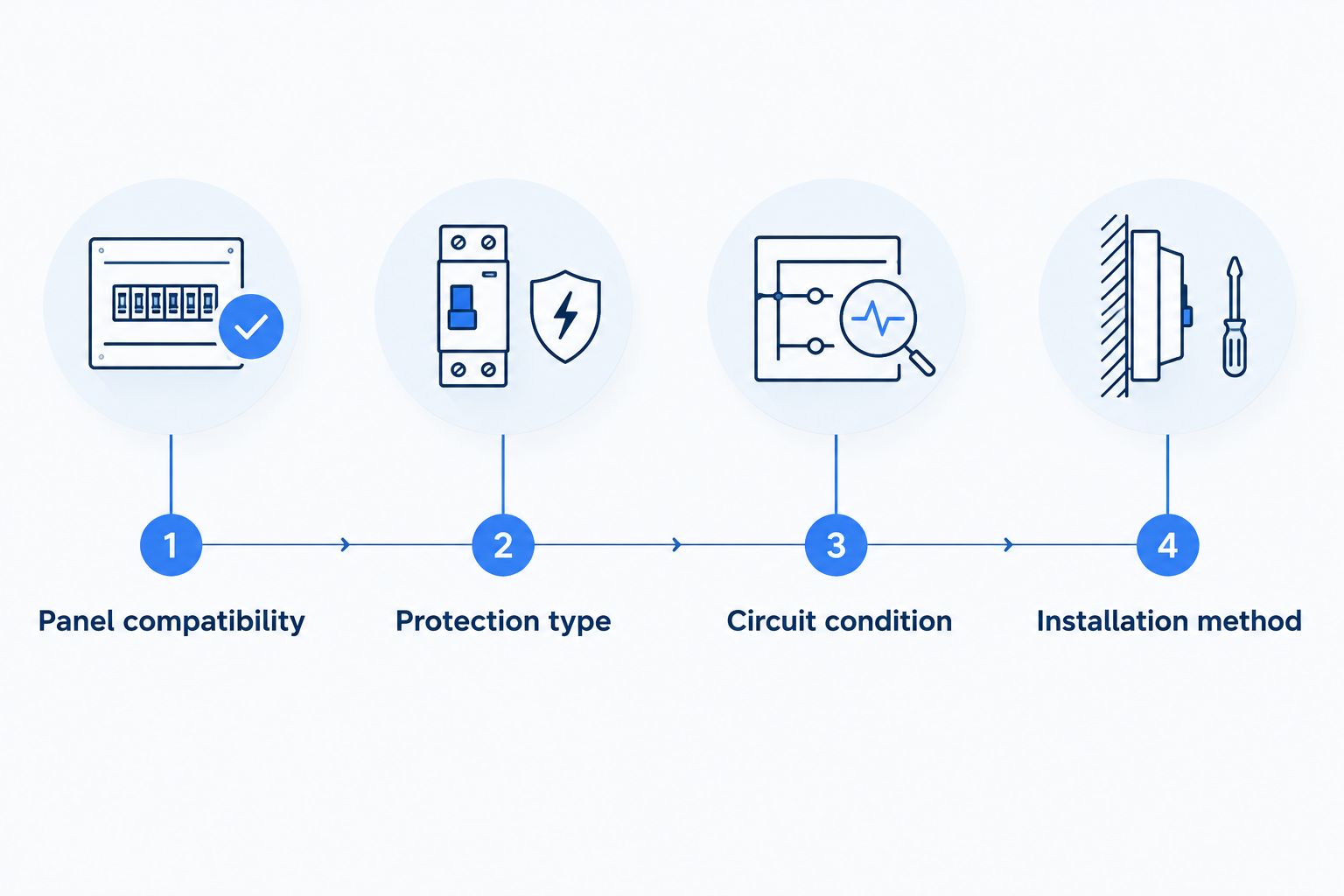
Use these criteria before choosing a device. None is optional just because a breaker looks familiar.
- Panel compatibility: The breaker must be identified for use in the exact panel. Physical fit alone proves nothing.
- Protection type: Combination AFCI and dual-function AFCI/GFCI mean different things. Match the protection to the circuit's requirements.
- Circuit condition: Damaged insulation, incorrect connections, and neutral problems need repair. A protective device does not fix them.
- Installation method: Neutral connections and any shared-neutral arrangement must match the device instructions and applicable requirements.
- Testing access: You need access to the test function and clear instructions for checking the installed device.
The selection order is simple: identify the panel, establish the required protection, inspect the circuit, and confirm the installation method. In 2026, the package wording still matters more than a broad claim that a device is “new” or “advanced.”
Home AFCI options at a glance
These options serve different installation needs. They are not interchangeable upgrades, and none replaces an inspection when the wiring condition is uncertain.
| Rank and option | Best for | Standout feature | Key limitation |
|---|---|---|---|
| 1. Combination AFCI breaker | Compatible circuits needing arc-fault protection without added GFCI protection | Addresses series and parallel arcing conditions | Does not provide GFCI protection unless explicitly marked dual-function |
| 2. Dual-function AFCI/GFCI breaker | Compatible circuits requiring both protection types | Combines AFCI and GFCI functions in one breaker | Requires correct circuit and neutral configuration |
| 3. Outlet branch-circuit AFCI | Qualifying outlet-based retrofit arrangements | Places AFCI testing and resetting at an outlet location | Does not automatically protect all wiring upstream of the device |
1. Combination AFCI breaker: best for arc-fault-only needs
A combination AFCI breaker provides overcurrent protection and detects the arcing conditions covered by its listing. “Combination” refers to arc-fault detection capabilities, including series and parallel arcing. It does not mean combined AFCI and GFCI protection.
This is the default choice when a circuit needs AFCI protection, does not need added GFCI protection, and has a suitable panel and wiring arrangement. It places the protective device at the circuit's origin rather than at a downstream outlet.
Combination AFCI breaker pros
- Places arc-fault protection at the panel for the branch circuit.
- Combines circuit overcurrent protection and AFCI functions in one device.
- Leaves ordinary downstream receptacles available where otherwise permitted.
- Provides a test function at the breaker.
Combination AFCI breaker cons
- Does not supply GFCI protection unless the device explicitly includes it.
- Must match the panel's permitted breaker application.
- Requires investigation if existing circuit wiring prevents correct operation.
Best for: Homeowners adding AFCI protection to a compatible circuit where separate ground-fault protection is not required or is already correctly addressed.
For common 120-volt household branch circuits, the electrician must also match the breaker rating to the conductors and circuit design. A 15-amp circuit does not become a 20-amp circuit because someone installs a larger breaker. Never increase the breaker rating to stop trips.
Verdict: Buy only after a licensed electrician confirms panel compatibility, circuit condition, and the required protection.
2. Dual-function AFCI/GFCI breaker: best for both protections
A dual-function breaker combines arc-fault circuit-interrupter and ground-fault circuit-interrupter protection. AFCI protection addresses arcing hazards; GFCI protection addresses ground-fault shock hazards. One function does not substitute for the other.
Choose this approach when the circuit requires both protections and the panel accepts an appropriate device. For a 2026 remodel, have the electrician establish the requirements before deciding whether protection belongs at the breaker, receptacle, or a permitted combination of devices.
Dual-function AFCI/GFCI breaker pros
- Provides both AFCI and GFCI functions in one breaker.
- Centralizes testing and resetting at the panel.
- Avoids confusing “combination AFCI” wording with actual dual-function protection.
- Provides a clear option when both protection requirements apply to the circuit.
Dual-function AFCI/GFCI breaker cons
- A trip interrupts the entire protected circuit, not just one outlet.
- Correct neutral routing is essential; existing wiring problems need correction.
- Does not resolve damaged wiring or equipment leakage by itself.
Best for: Homeowners whose circuit needs both arc-fault and ground-fault protection and supports a compatible dual-function breaker.
A shared neutral deserves particular attention. An electrician must identify the circuit arrangement and select a permitted protection method. Do not assume an ordinary single-pole device will suit every existing circuit.
Verdict: Buy when both protections are required and the electrician has confirmed a compatible installation.
3. Outlet branch-circuit AFCI: best for qualifying retrofits
An outlet branch-circuit AFCI provides arc-fault protection at an outlet location. Its protection depends on the device's listing, placement, wiring, and the installation method. Installing one in a convenient bedroom outlet does not automatically make the whole circuit compliant.
This option needs particular care around the wiring between the panel and the device. That upstream portion is not automatically covered the same way as a circuit protected by an AFCI breaker at its origin.
Outlet branch-circuit AFCI pros
- Places the test and reset controls at an accessible outlet location.
- Can serve a qualifying retrofit where the installation method permits it.
- Provides an alternative protection location when properly designed.
Outlet branch-circuit AFCI cons
- Does not automatically protect all upstream branch-circuit wiring.
- Requires correct placement and identification of line and load conductors.
- Is not a universal substitute for an AFCI breaker.
Best for: Homeowners with an electrician-confirmed retrofit arrangement that permits outlet-based AFCI protection.
Do not buy this device simply because the panel lacks a convenient breaker option. The electrician must first establish whether the entire proposed arrangement meets the applicable requirements. An unsuitable panel or damaged circuit needs a separate solution.
Verdict: Hold until a licensed electrician confirms the installation qualifies.
How these AFCI options were ranked
The ranking puts panel compatibility and required protection ahead of convenience. A combination AFCI breaker is the default only for circuits that need its particular protection. A dual-function breaker moves into first place when both AFCI and GFCI protection are required.
Outlet-based AFCI protection ranks third because placement and upstream wiring require a more specific installation review. This is an application ranking for 2026—not a claim that every home needs the same device.
What to check before requesting a quote
You do not need to open the panel to make a useful request. Gather what you can see safely, then leave the internal inspection to the electrician.
- Panel identification: Photograph the visible manufacturer information and circuit directory without removing covers.
- Affected circuit: List the rooms, outlets, and equipment that lose power when the breaker trips.
- Trip pattern: Note what was operating and whether the trip happened immediately or after use.
- Project scope: Explain whether you are repairing a fault, remodeling, adding a circuit, or replacing a panel.
- Warning signs: Report burning smells, discoloration, buzzing, or heat at outlets and equipment.
Do not touch suspect equipment to check its temperature. If there is smoke, fire, or active sparking, keep clear and call emergency services. Do not remove the panel cover or handle wiring to get a better photograph.
Eagle Electric emphasizes same-business-day responses to quote requests and clear written quotes. Use the quote request to describe the problem and project scope. A response is not a promise of same-day job completion.
Request a written electrical quote
Describe the circuit problem. Eagle Electric emphasizes same-business-day responses to quote requests.
What a clear AFCI scope should cover
A useful written scope identifies the affected circuit and proposed protection type. It should distinguish device installation from fault diagnosis, wiring repairs, and any panel work. Those are different tasks.
Ask who will confirm permit and inspection requirements. Also ask how the circuit will be tested and labeled after installation. For your 2026 project, get the proposed work in writing before authorizing changes.
Do not treat a panel replacement as an automatic requirement for every AFCI project. The electrician needs to inspect the existing equipment first. Likewise, do not accept a breaker swap as the complete answer when damaged wiring remains.
Which home AFCI option should you choose?
Choose a panel-compatible combination AFCI breaker when you need arc-fault protection alone. Choose a dual-function AFCI/GFCI breaker when the circuit needs both protections. Use an outlet branch-circuit AFCI only when the electrician confirms the proposed arrangement qualifies.
For an older North Dakota home, the next move is an on-site inspection—not buying a box of breakers. Ask the electrician to identify the panel, inspect the circuit arrangement, and explain the protection required for the work. That produces a defensible choice instead of a guess.
FAQ
What are the best arc fault circuit interrupters for homes?
The best arc fault circuit interrupters for homes are devices approved for the panel and suited to the circuit's protection requirements. A combination AFCI breaker suits qualifying arc-fault-only applications; a dual-function AFCI/GFCI breaker suits circuits needing both protections.
Does a combination AFCI breaker include GFCI protection?
No. Combination AFCI describes arc-fault detection capabilities, not combined AFCI and GFCI protection. Look for an explicitly identified dual-function AFCI/GFCI device when both functions are needed.
Can I replace a regular breaker with an AFCI myself?
Have a licensed electrician assess and perform the replacement. Panel compatibility, conductor ratings, neutral arrangements, and applicable requirements must all be checked, and parts inside a panel can remain energized even when the main breaker is off.
Why does my AFCI breaker keep tripping?
Repeated AFCI trips require diagnosis rather than an assumption that the breaker is bad. Wiring faults, neutral problems, and connected equipment can be involved. Do not bypass the protection or repeatedly reset a circuit showing signs of damage.
Can an AFCI outlet replace an AFCI breaker?
An outlet branch-circuit AFCI is an alternative only when the complete installation meets the applicable requirements. Its location and upstream wiring matter. A licensed electrician must confirm the arrangement before installation.
Do all North Dakota homes need AFCI breakers in 2026?
There is no single retrofit answer for every existing North Dakota home. Requirements depend on the applicable rules, circuit location, and work being performed. Have the electrician confirm the requirements for your address and project.
Does a 200-amp panel tell me which AFCI to buy?
No. A 200-amp service rating does not identify the breaker approved for an individual branch circuit. The electrician still needs the panel identification, circuit rating, wiring arrangement, and required protection type.
One last thing
A breaker that trips is not an invitation to install a larger breaker. Its rating protects the circuit conductors, and AFCI protection adds a different safety function. Neither substitutes for sound wiring.
Keep a short record of trips and what was running. Give that record to the electrician before the visit. It provides a starting point without asking you to open a panel or troubleshoot live wiring.


