
Best overall for widespread unsafe wiring: full branch-circuit replacement. Best for occupied homes: phased rewiring; best for isolated deficiencies: targeted circuit replacement; best during a gut renovation: open-wall rewiring. This 2026 guide explains how to choose the scope before requesting Eagle Electric residential electrical services.
- The best whole house rewiring solutions start with an on-site inspection, not an automatic panel upgrade.
- Full branch-circuit replacement addresses widespread wiring deficiencies; phased rewiring divides the work into planned stages.
- Targeted circuit replacement fits isolated problems, but it is not a whole-house rewire.
- Eagle Electric is a fit for Bakken homeowners seeking a licensed residential electrical contractor.
- Request a clear written quote that identifies circuit work, wall repairs, inspections, and planned power interruptions.
Why this matters
A new breaker panel does not replace deteriorated wiring behind plaster. A grounded-looking receptacle does not prove that a grounding path exists. Start with what the house actually has.
Older North Dakota homes can contain wiring from several renovations. The electrician needs to identify what remains energized, how circuits are connected, and which deficiencies require correction. Age alone does not establish that every wire needs replacement.
For your 2026 project, separate three decisions: wiring condition, circuit capacity, and service capacity. They belong in the same assessment, but they are not interchangeable jobs.
What makes the best whole house rewiring solutions?
Use these criteria before comparing scopes. The right solution fixes documented problems without leaving hidden assumptions in the quote.
- Verified condition: Have a licensed electrician assess accessible wiring, connections, grounding, and protective devices. Concealed conditions need further investigation where warranted.
- Complete circuit scope: Identify which circuits get replaced, which remain, and how abandoned wiring gets handled.
- Load planning: Account for existing appliances and planned additions. Do not choose service capacity from the house's age alone.
- Practical access: Establish how the electrician will reach wiring through walls, ceilings, attic spaces, or the basement.
- Occupied-home planning: Define power interruptions, work areas, and the condition in which each stage ends.
- Written accountability: Specify permitting, inspections, testing, labeling, exclusions, and responsibility for finish repairs.
Rewiring options at a glance
These are work scopes, not competing contractors. Full replacement describes the extent of the work; phased and open-wall rewiring describe how that work is delivered.
| Solution | Best for | Standout feature | Key limitation |
|---|---|---|---|
| Full branch-circuit replacement | Widespread unsafe or unsuitable wiring | Replaces affected wiring throughout the home | Requires access across multiple rooms |
| Phased rewiring | Occupied homes needing extensive work | Divides replacement into planned stages | Unsafe circuits cannot remain active just to preserve the schedule |
| Targeted circuit replacement | Isolated deficiencies in an otherwise serviceable system | Addresses a defined circuit or load | Does not correct unrelated concealed defects |
| Open-wall rewiring | Gut renovations and major room rebuilds | Coordinates wiring with exposed framing | Requires coordination before walls close |
1. Full replacement: best for widespread wiring deficiencies
Full branch-circuit replacement replaces wiring serving receptacles, lighting, and connected equipment across the agreed scope. It is the strongest choice when an inspection identifies problems throughout the home rather than in one isolated area. Panel or service work remains a separate scope decision.
Do not accept the phrase whole-house rewire without a circuit-level description. Ask whether the work includes lighting feeds, switches, appliance circuits, accessible junctions, grounding provisions, and removal or disconnection of abandoned wiring.
A house can have modern wiring in an addition and older wiring elsewhere. The quote should explain what stays and why. It should also distinguish areas inspected directly from areas that require access during construction.
Full replacement pros:
- Addresses widespread wiring deficiencies under one coordinated plan.
- Allows circuit layout to match the home's intended use.
- Establishes a clear opportunity to document and label the finished system.
Full replacement cons:
- Requires access in multiple parts of the house.
- Wall and ceiling restoration need their own defined scope.
Best for: Homeowners whose inspection establishes that extensive replacement is necessary.
Verdict: Buy when documented conditions justify full replacement—not because the house is old.
2. Phased rewiring: best for an occupied home
Phased rewiring breaks an extensive replacement project into defined work areas or circuit groups. You still need a whole-house plan. The difference is the sequence, not a lower safety standard.
Before work starts, identify which rooms and essential equipment need power during each stage. Heating controls, refrigeration, medical equipment, and water systems deserve explicit discussion. Temporary arrangements require an electrician's approval; extension cords are not a substitute for permanent wiring.
Ask how the electrician will separate new work from retained circuits and verify each completed stage. If a circuit presents an immediate hazard, keeping it energized for convenience is not an acceptable staging plan.
For a 2026 occupied-home project, insist on written shutdown coordination. A response to your quote request is not a promise that the electrical work will finish that day.
Phased rewiring pros:
- Organizes disruption around defined work areas.
- Allows completed stages to be documented as work progresses.
- Connects immediate repairs to an eventual whole-house plan.
Phased rewiring cons:
- Requires careful coordination between old and new wiring.
- Some conditions require shutdowns that disrupt normal occupancy.
Best for: Homeowners remaining in the house during extensive electrical work, where conditions permit safe staging.
Verdict: Buy only with a written sequence and a safe stopping point for every stage.
3. Targeted replacement: best for isolated circuit problems
Targeted circuit replacement addresses a specific deficiency or adds a properly designed circuit for a particular load. It fits a home where the broader system remains serviceable after assessment. It is not a whole-house rewire.
Examples include replacing a damaged branch circuit or providing a dedicated circuit where an appliance requires one. A licensed electrician must determine the conductor, breaker, grounding, and protective-device requirements for that installation.
Ordinary household circuits commonly supply 120 volts. Equipment such as an electric range or dryer can require 240 volts. Those voltage differences do not determine circuit sizing by themselves; the equipment requirements and installation conditions matter.
Repeated breaker trips require diagnosis. Do not install a larger breaker to stop tripping without verifying the circuit's conductors and equipment.
Targeted replacement pros:
- Keeps the scope focused on a documented problem.
- Avoids replacing serviceable circuits solely because of age.
- Supports a specific appliance or room requirement.
Targeted replacement cons:
- Leaves unrelated wiring outside the replacement scope.
- Does not establish that concealed wiring elsewhere is sound.
Best for: A defined circuit problem in a home whose remaining electrical system has been assessed.
Verdict: Buy for an isolated deficiency; skip as a substitute for necessary whole-house work.
4. Open-wall rewiring: best during a gut renovation
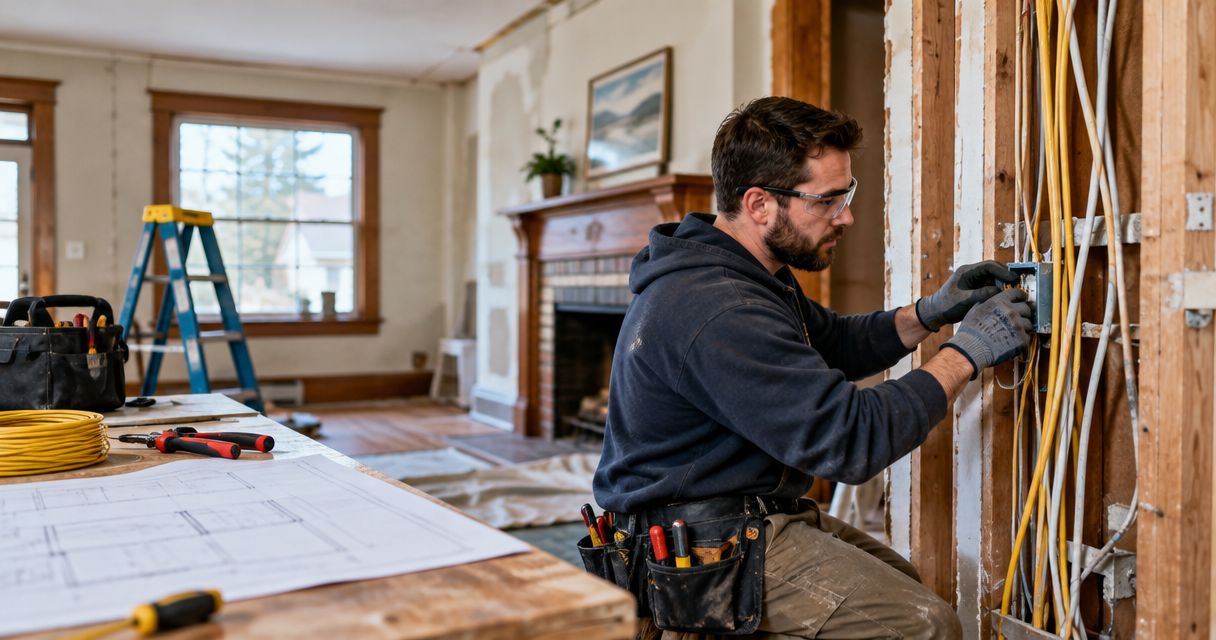
Open-wall rewiring coordinates electrical replacement with exposed framing. It lets the electrician plan cable routes, boxes, and circuit changes before finishes cover the work. The replacement scope still depends on the inspection and renovation plan.
Make electrical decisions before the walls close. Kitchen equipment, laundry locations, lighting controls, and planned room uses all affect the layout. Changing those decisions afterward creates additional access work.
For your 2026 renovation, put the electrical inspection stage on the construction schedule. Confirm the required approvals before insulation, drywall, or other finishes conceal the installation. The electrician and remodeling contractor need a shared sequence.
Open-wall rewiring pros:
- Gives direct access to wiring routes within exposed areas.
- Coordinates device placement with the finished room layout.
- Supports inspection before the work is concealed.
Open-wall rewiring cons:
- Depends on coordination with the renovation schedule.
- Does not automatically address wiring outside the opened areas.
Best for: Homeowners already opening walls for a major renovation.
Verdict: Buy when demolition is already planned and the electrical scope covers the affected circuits.
Do you need a panel upgrade too?
A panel upgrade and a rewire solve different problems. The panel distributes and protects circuits. Branch-circuit wiring carries power from that equipment to loads throughout the house.
A 200-amp panel is not an automatic requirement for an older home. Have the electrician assess the existing service, equipment condition, and calculated load before recommending capacity. A larger panel does not correct damaged insulation or improper connections downstream.
Likewise, replacing branch circuits does not establish that the existing service equipment is suitable. Your written scope should say whether the panel stays, changes, or needs further evaluation. Keep those decisions separate enough to understand each recommendation.
What a clear written rewiring quote should include
Eagle Electric emphasizes same-business-day responses to quote requests and clear written quotes. A response starts the conversation; an on-site inspection establishes the work. It is not a same-day completion promise.
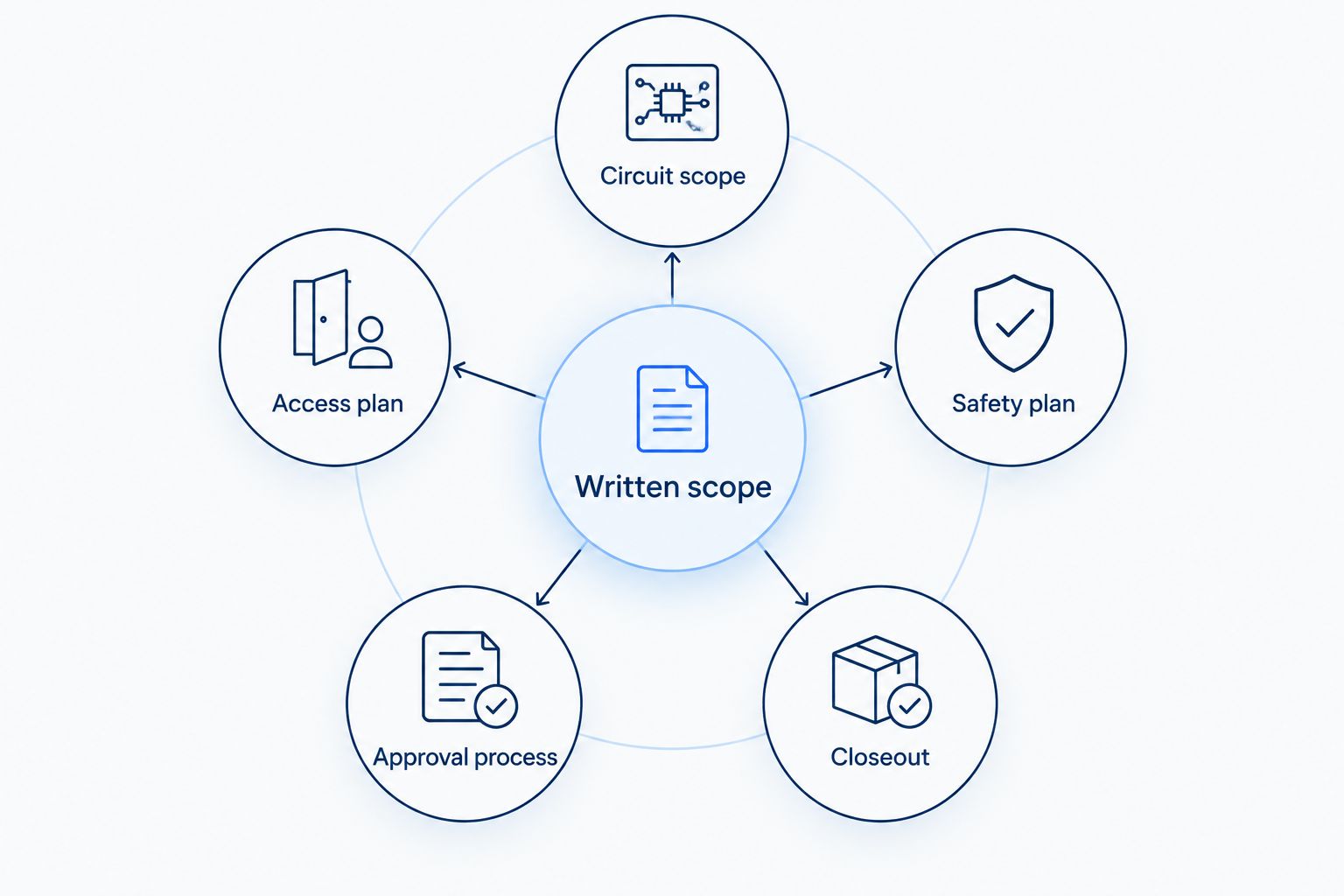
For a 2026 rewiring project, ask for these items in writing:
- Circuit scope: Rooms, circuits, equipment connections, and wiring that will remain.
- Access plan: Expected openings and who handles patching, painting, and cleanup.
- Safety plan: Required shutdowns and how incomplete work areas will be secured.
- Approval process: Responsibility for applicable permits and inspections.
- Closeout: Testing, circuit identification, and documentation of completed work.
- Change process: How newly exposed conditions will be documented and approved.
The homeowner's job is to describe symptoms and planned equipment, not to open electrical equipment. Leave panel covers, concealed wiring investigation, and electrical testing to the licensed electrician.
Write down where lights flicker, which breakers trip, and what equipment was operating. Share existing renovation plans and appliance information. Do not repeatedly reproduce a fault to demonstrate it.
Request a written rewiring quote
Describe the house, known wiring problems, and renovation plans. An on-site assessment defines the work.
How these solutions are ranked
The ranking follows wiring condition first, then project scope, access, and occupancy. Full replacement leads for widespread deficiencies. Phased work fits safe staging, targeted work fits isolated problems, and open-wall work fits renovation access.
These are conditional recommendations, not a remote diagnosis. Eagle Electric residential electrical services cover Bakken homeowners; the correct rewiring scope requires an on-site assessment of your house.
Which rewiring solution should you choose?
Choose the smallest scope that fully corrects the documented deficiencies. That is not always the smallest job. Widespread unsafe wiring calls for a wider replacement plan, while an isolated circuit problem does not automatically justify stripping the whole house.
If you are undecided, request an assessment before choosing between replacement methods. Ask for a written explanation of what must change, what can remain, and what concealed conditions could change the scope.
FAQ
What's the best whole house rewiring solution for an older ND home?
Full branch-circuit replacement is the strongest choice when an inspection identifies widespread unsafe or unsuitable wiring. Phased work and open-wall access are ways to deliver that replacement. An on-site assessment determines the right scope.
Can I stay in my house while it is rewired?
Occupancy depends on the work areas, shutdowns, and whether essential systems can operate safely. Ask the licensed electrician for a staging plan before assuming you can remain throughout the project.
Does a new panel mean my house has been rewired?
No. Panel replacement does not replace branch-circuit wiring inside walls and ceilings. Ask which circuits were replaced and which remain.
Does every older home need a 200-amp panel?
No. Service capacity depends on the calculated load and the suitability of the existing equipment. The house's age alone does not establish the required capacity.
Should all knob-and-tube wiring be replaced immediately?
Knob-and-tube wiring requires an on-site assessment rather than an age-only decision. A licensed electrician must evaluate its condition, alterations, surrounding conditions, and applicable requirements before recommending the scope.
Can new GFCI receptacles replace a whole-house rewire?
No. GFCI protection does not repair deteriorated wiring or create an equipment grounding conductor. A licensed electrician must determine the appropriate protection and wiring corrections.
How do I request a rewiring quote from Eagle Electric?
Submit a quote request with the property details, known symptoms, and renovation plans. Eagle Electric emphasizes same-business-day responses and clear written quotes; the assessment determines scope and scheduling.
One last thing
Ask which old circuits will still be energized when the job is finished. That question cuts through vague whole-house language. The answer should match the written scope and the finished circuit labeling—not just the appearance of the new panel.


