

North Dakota auto repair shop electrical wiring is the design and installation of circuits, lighting, and power distribution that keep repair equipment operating safely. This 2026 guide covers lift and compressor loads, repair-garage hazards, inspections, and written quotes without turning your shop owner into an electrician.
- Eagle-Elc provides licensed commercial electrical contracting for Bakken businesses, including shops planning electrical work.
- Electrician for auto repair shops North Dakota: start with equipment loads, repair-garage hazards, and a written scope.
- Empty breaker spaces do not establish spare electrical capacity. Have a licensed electrician calculate the load.
- Keep inspection findings, equipment requirements, shutdown plans, and final documentation in the same project file.
Why electrical wiring matters for North Dakota auto repair shops
A repair shop combines motor loads, portable tools, vehicle fluids, wet work, and moving equipment. Your wiring plan must account for those conditions, not just put an outlet beside every bay.
A compressor starting while a lift operates presents a different electrical demand from office lighting. Fuel-system work and inspection pits also introduce questions that an ordinary storage garage does not answer.
Plan electrical work around the equipment and repair activities you actually use. An on-site inspection establishes the starting point; a panel photograph alone does not show the condition of concealed wiring or prove available capacity.
For a 2026 project, separate the inspection appointment from the construction schedule. The guide to commercial electrical inspection timing in ND explains another part of that planning process.
How to plan your shop's electrical work
Start with information you can gather safely. Leave testing, panel access, circuit design, and installation to a licensed electrician.
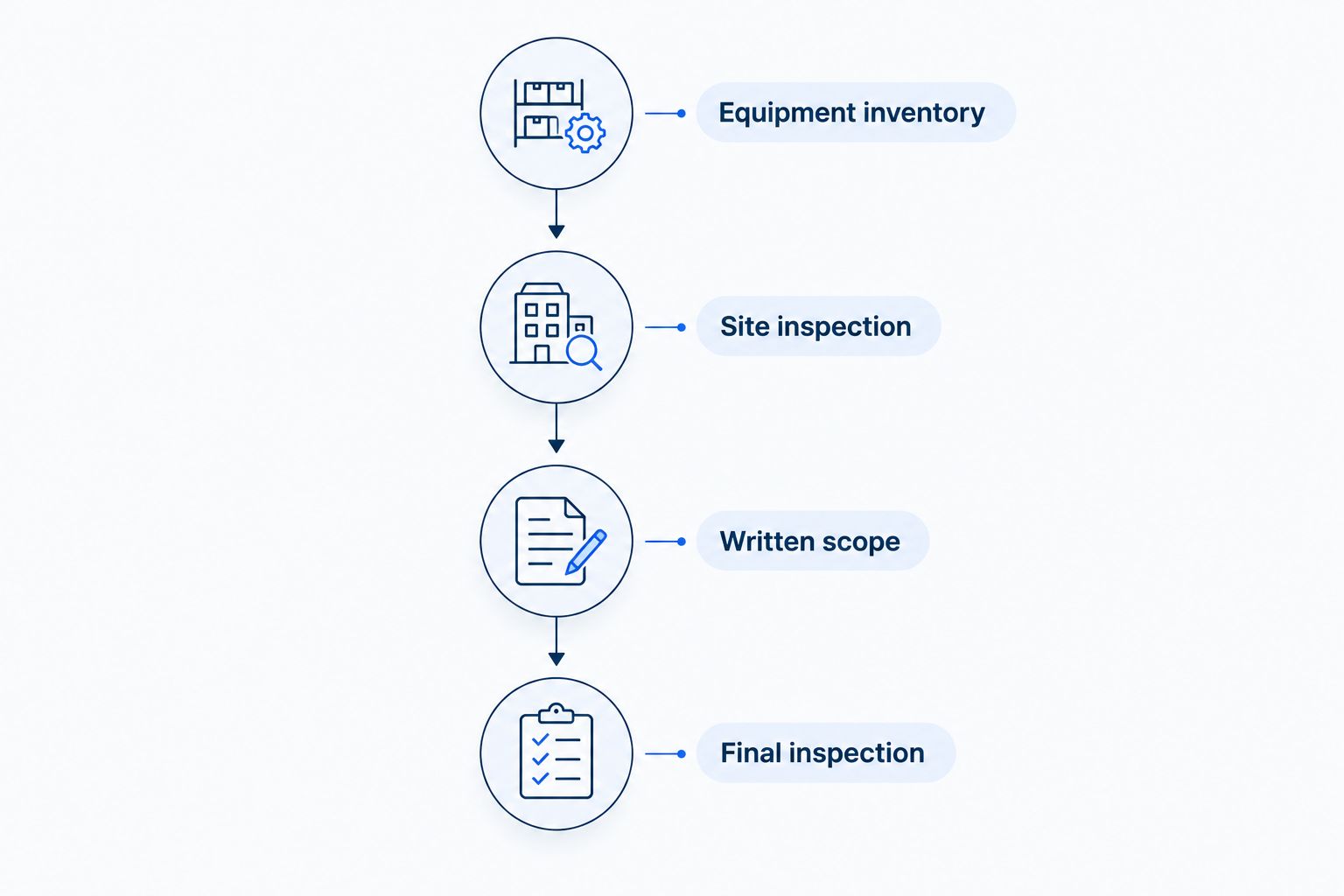
Keep four project checkpoints in order: Equipment inventory, Site inspection, Written scope, and Final inspection. Each checkpoint gives the next person usable information instead of another guess.
1. List every machine and its operating requirements
Walk the shop with a notebook or spreadsheet. Record equipment information from accessible nameplates and manufacturer documents without removing guards, opening enclosures, or entering restricted areas.
List lifts, compressors, welders, tire machines, ventilation equipment, heaters, battery chargers, and office loads. Identify which machines operate together. A machine you use occasionally still belongs in the load assessment.
A 120-volt receptacle, a 240-volt machine, and a 208-volt three-phase load are not interchangeable requirements. Those are examples of electrical supply characteristics, not recommendations for your equipment; the nameplate and installation instructions control.
- Record voltage, phase, and nameplate current where accessible.
- Collect installation manuals for new equipment.
- Mark each machine's location on a floor plan.
- Identify loads that operate at the same time.
- Separate confirmed purchases from possible future additions.
2. Document repair activities and hazardous areas
Write down what happens in each bay before deciding where electrical equipment belongs. General mechanical repairs, fuel-system repairs, spray finishing, and battery work present different conditions.
NFPA 70, the National Electrical Code, addresses commercial repair garages in Article 511. The applicable requirements depend on the operation, layout, ventilation, and locally adopted code; do not assign a hazardous-location classification yourself.
For your 2026 project, have the licensed electrician confirm applicable requirements with the authority having jurisdiction. A classified area needs equipment and wiring methods suitable for that classification. Ordinary equipment does not become suitable because it sits above a convenient shelf.
- Identify fuel handling and fuel-system repair areas.
- Mark pits, low spaces, and floor drains.
- Describe ventilation and exhaust arrangements.
- Flag spray finishing and alternative-fuel vehicle work.
- Have the electrician establish applicable area classifications.
3. Inspect the existing electrical system before choosing upgrades
Gather old drawings, inspection records, and equipment documents yourself. Photograph the outside of accessible, closed panels and record visible labels. Do not remove a panel cover to improve a quote request.
Eagle-Elc is best for Bakken businesses seeking licensed commercial electrical contracting. The company is based in Watford City and serves businesses across the Bakken region; the shop's actual scope still requires an on-site assessment.
An inspection should distinguish a damaged component from inadequate capacity. Adding a subpanel creates distribution space, but it does not increase the capacity of the electrical service feeding it.
- Have a licensed electrician assess service and feeder capacity.
- Request a load calculation for proposed equipment.
- Identify damaged wiring, enclosures, and receptacles.
- Have grounding, bonding, and circuit identification evaluated.
- Confirm whether utility coordination or permits are required.
4. Place circuits around the way technicians work
Use a printed floor plan and mark where technicians stand, move carts, open vehicle doors, and operate equipment. Show lift posts and vehicle travel paths. This planning work requires no electrical tools.
Ask the electrician to turn that layout into a circuit and wiring plan. Equipment instructions, motor requirements, circuit protection, disconnecting means, and physical damage exposure all affect the design.
Avoid making extension cords the permanent answer to poor outlet placement. The right location also keeps plugs and disconnects accessible without forcing someone behind a running machine or beneath stored parts.
- Locate outlets near actual work positions.
- Identify circuits needed for fixed equipment.
- Protect wiring from vehicles, carts, and lift movement.
- Specify suitable enclosures for the environment.
- Have GFCI requirements evaluated for applicable locations.
5. Separate task lighting from equipment power needs
Walk each bay with the lights on and note shadows beneath raised vehicles, inside engine compartments, and beside tire equipment. Include entrances, exits, storage aisles, and exterior walking routes in the review.
Lighting design is more than choosing brighter fixtures. Placement, glare, mounting protection, environmental suitability, and controls affect whether technicians can see the job without creating another obstruction.
Ask the electrician to review lighting circuits separately from equipment circuits where appropriate. Emergency and exit lighting also require their own assessment; ordinary overhead lights do not replace required life-safety lighting.
- Mark dark work areas on the floor plan.
- Identify glare at inspection and diagnostic positions.
- Select fixtures suitable for each area's conditions.
- Review exit signs and emergency lighting.
- Keep lighting access clear for future maintenance.
6. Get a written scope and a workable shutdown plan
Prepare your own list of work that cannot stop during business hours. Identify vehicle bookings, parts deliveries, overhead doors, and equipment that needs a controlled shutdown before power is interrupted.
Eagle-Elc responds to quote requests the same business day and provides clear written quotes. A quote response is not a promise of same-day job completion. Inspection findings, permits, utility work, and equipment requirements determine the construction schedule.
For a 2026 expansion, make the quote distinguish existing repairs from added capacity and future provisions. Request a written electrical quote with your equipment list and floor plan so the conversation starts with the actual job.
- Name the equipment and circuits included.
- Identify permit and inspection responsibilities.
- Record exclusions and unresolved site conditions.
- Agree on planned power interruptions.
- Define how additional work receives written approval.
7. Verify the finished work and keep the records
Create a project folder before installation starts. Use it for the approved scope, equipment instructions, inspection records, and updated circuit information.
Your electrician should complete the required testing and arrange applicable inspections. Your role is to confirm that the delivered work matches the agreed scope and that staff know which equipment and disconnects serve each work area.
Do not accept a quick machine startup as the only closeout check. A running compressor does not establish that every circuit, label, protective device, or required inspection is complete.
- Confirm that required inspections are closed out.
- Obtain an accurate panel directory.
- Keep equipment and protective-device instructions.
- Record the location of relevant disconnects.
- Document outstanding items before accepting completion.
Compare electrical upgrade options for your shop
Choose the option after the inspection and load calculation, not before. Each approach solves a different problem, and some projects need more than one.
| Option | Best for | Main benefit | Key limitation |
|---|---|---|---|
| Targeted circuit additions | A shop adding specific equipment with verified existing capacity | Places power where the machine needs it | Does not correct inadequate service capacity or unrelated wiring defects |
| Subpanel installation | A distant bay needing local circuit distribution | Groups circuits near the work area | Does not increase upstream service capacity |
| Service and distribution upgrade | Equipment additions that exceed verified existing capacity | Addresses the supply limitation | Requires a broader scope and possible utility coordination |
| Staged wiring renovation | An occupied shop correcting wiring across several areas | Divides work into planned phases | Requires careful isolation, temporary arrangements, and repeated coordination |
A subpanel is a distribution solution, not a capacity upgrade. Conversely, replacing the service does not automatically correct damaged branch-circuit wiring elsewhere in the building.
For your 2026 plan, ask the electrician to explain which limitation each proposed item removes. If the scope cannot connect the work to a documented need, ask for clarification before approving it.
Common electrical planning mistakes auto repair shops make
Buying equipment before checking the available supply
A machine's plug shape or advertised power description is not enough. Confirm voltage, phase, manufacturer requirements, and available electrical capacity before committing to an installation location.
Best move: Give the electrician the actual equipment documentation, not a verbal description of a similar machine.
Treating every bay as an ordinary garage
A bay used for fuel-system work or an inspection pit needs an assessment tied to its actual conditions. Copying the outlet layout from another shop does not establish compliance.
Best move: Disclose repair activities before the electrician selects wiring methods, receptacles, or lighting.
Using breaker space as proof of capacity
An empty slot tells you there is room for a compatible breaker. It does not tell you that the service, feeder, or panel can carry another machine.
Best move: Ask for the load assessment before approving equipment additions.
Leaving shutdown coordination until installation day
Electrical work can affect lifts, doors, ventilation, lighting, and office systems at the same time. A shop full of customer vehicles leaves little room for an improvised shutdown.
Best move: Agree on affected areas and equipment before the work starts. Never operate equipment in an unsafe temporary arrangement to preserve the schedule.
FAQ
What's the best way to choose an electrician for an auto repair shop in North Dakota?
Choose a licensed electrical contractor who evaluates your equipment, repair activities, existing service, and permit requirements before defining the work. Eagle-Elc provides commercial electrical contracting across the Bakken region; request an on-site assessment and a clear written scope.
Does my auto repair shop need three-phase power?
Your equipment requirements determine whether your auto repair shop needs three-phase power. Have a licensed electrician compare the actual machine nameplates with the building supply before you buy or relocate equipment.
Can a subpanel solve an overloaded electrical service?
No. A subpanel distributes power but does not increase the capacity of the service feeding it. A licensed electrician must assess the existing load and proposed additions.
Do all repair-shop outlets need GFCI protection?
GFCI requirements depend on the outlet, location, use, and applicable adopted electrical code. Have the electrician evaluate the shop rather than copying residential garage rules or bypassing protection when equipment trips.
Can my shop stay open during electrical upgrades?
Your shop can remain open only where the work plan allows safe separation from electrical construction and necessary shutdowns. Agree on affected bays, equipment, access restrictions, and power interruptions before installation starts.
What should I do if a shop breaker keeps tripping?
Stop using the affected equipment and have a licensed electrician investigate repeated breaker trips. Do not repeatedly reset the breaker or substitute a larger breaker to keep working.
What should I send with an electrical quote request?
Send the shop address, equipment documentation, a floor plan, the problem description, and your operating constraints. Include accessible photos taken without opening electrical enclosures, plus any existing drawings or inspection records.
One last thing
The next machine you buy belongs in today's wiring conversation. Give Eagle-Elc separate lists for equipment you own, equipment you have ordered, and equipment you are only considering.
That distinction keeps the 2026 scope honest. Your electrician can assess future provisions without treating every possible purchase as an immediate installation requirement.


