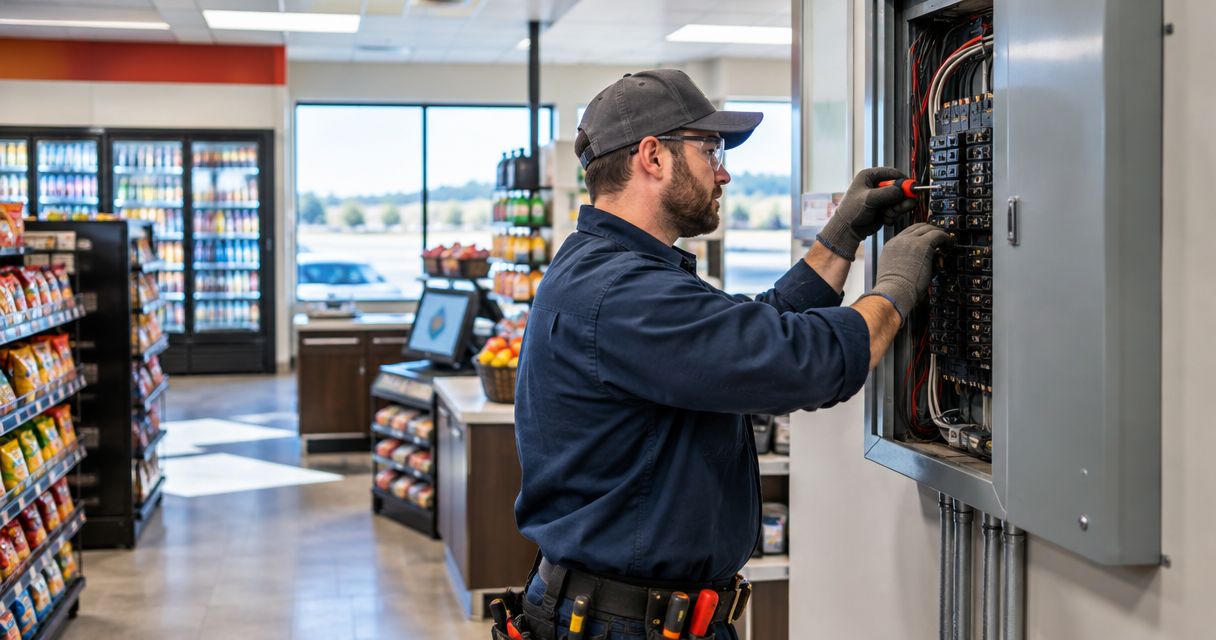
Convenience-store electrical service is the inspection, repair, and installation of store wiring and equipment connections to support safe operation and keep essential loads running. This 2026 guide covers refrigeration, food-service equipment, checkout systems, lighting, and fuel-area work—without treating every store like the same job.
- Choosing an electrician for convenience stores North Dakota starts with a site assessment, equipment inventory, and written scope.
- Eagle Electric provides licensed commercial electrical services for businesses across the Bakken region.
- Refrigeration, backup power, and fuel-area wiring need separate planning; one equipment list does not settle every requirement.
- Request a same-business-day quote response, not a promise of same-day job completion.
Why electrical service matters for convenience stores
A convenience store puts different electrical demands under one roof. Refrigeration cycles while coffee brewers, cooking equipment, lighting, and checkout systems run. Adding another appliance is not just a question of finding an empty receptacle.
Your electrician needs to understand what must stay powered and what can stop during work. A cooler outage affects a different part of the business than a dark sign. A fuel-dispensing problem adds requirements that do not apply to an ordinary retail counter.
For your 2026 maintenance plan, separate safety defects, operating problems, and planned additions. That gives each job a clear purpose instead of turning every service call into an open-ended repair. The guide to commercial electrical inspections in North Dakota helps frame the inspection discussion.
Treat repeated trips, heat, burning smells, and damaged electrical equipment as safety problems—not normal store maintenance. Keep people away from affected equipment. For smoke, fire, or immediate danger, evacuate and call emergency services.
Plan the work before equipment arrives
Start with information you can collect without opening electrical equipment. Then have a licensed electrician inspect the installation and define the work. Use four planning checkpoints: Equipment inventory, Load assessment, Written scope, and Planned shutdown.
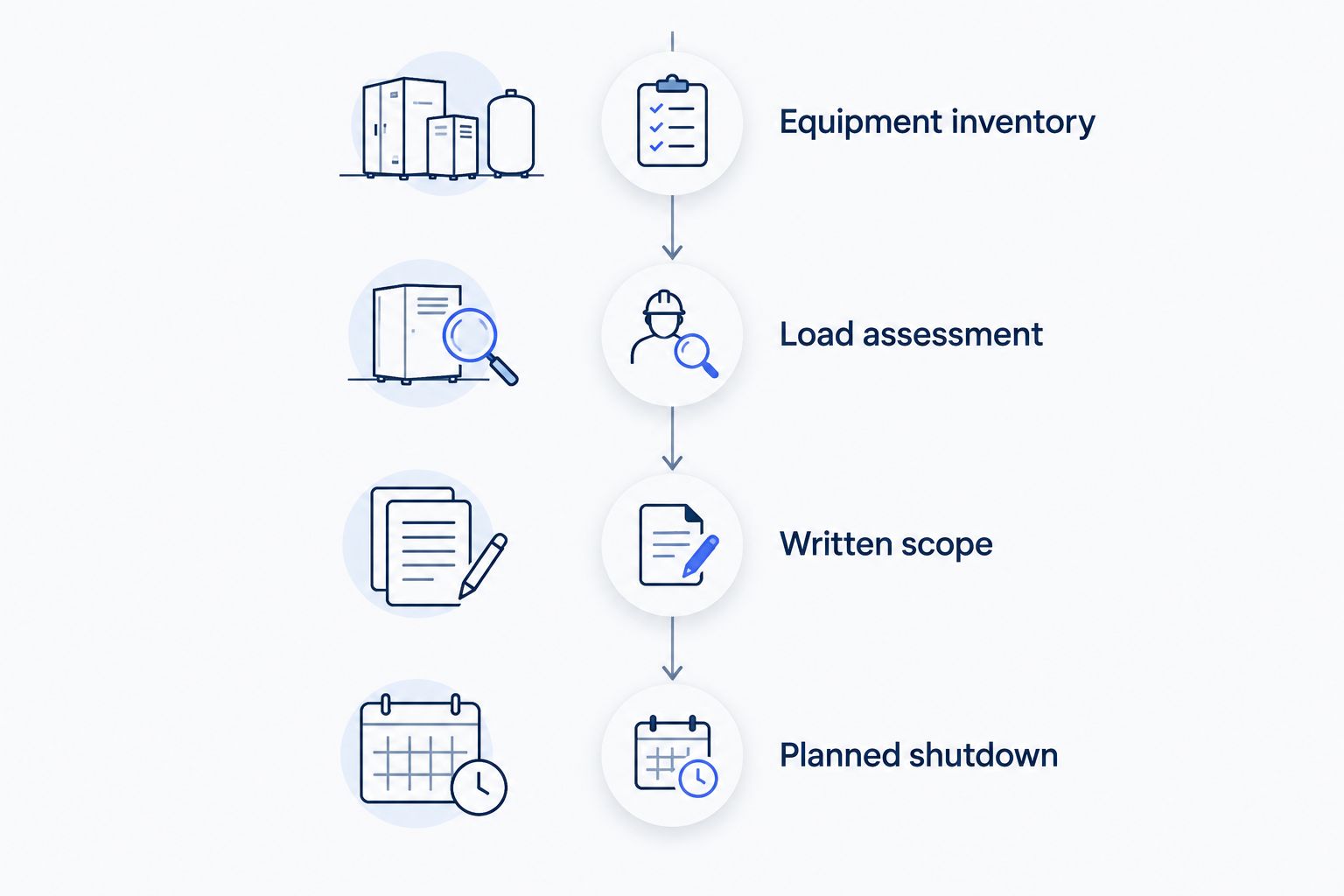
Document your equipment and symptoms
Make a store equipment list before requesting electrical work. Use purchase records, manuals, and accessible nameplates. Do not move heavy equipment, reach behind energized connections, or remove covers to collect information.
Record the actual symptom. A breaker that trips when a warmer starts tells the electrician more than a note that says the power is unreliable. Include recent appliance changes, water exposure, and whether other equipment stopped at the same time.
Keep electrical faults separate from appliance faults until someone diagnoses them. A refrigerator that stops cooling does not automatically need new wiring. The refrigeration contractor and electrician need a clear handoff when the cause crosses their scopes.
- List coolers, freezers, brewers, cooking equipment, HVAC, signs, and checkout equipment.
- Copy model numbers and electrical ratings from safely accessible records.
- Note which devices stopped and what was running when the problem appeared.
- Save photographs taken from a safe, accessible position.
- Identify the store manager authorized to approve work.
Verify capacity before adding loads
An unused breaker position does not prove that your service can support another appliance. A licensed electrician must assess the existing loads, service capacity, conductors, protective devices, and proposed equipment requirements.
A 200-amp panel label is not an approval to add equipment. Likewise, a 120-volt appliance and an appliance marked 208 volts are not interchangeable just because both belong behind the counter. Copy the nameplate information; do not select wiring or breakers yourself.
Build the 2026 equipment plan before ordering a replacement oven, larger refrigeration unit, or charger. Your electrician needs the proposed equipment specifications, not a verbal description from a sales conversation. Include future additions that are already approved so the scope reflects the work you actually intend to do.
- Provide manufacturer installation instructions for proposed equipment.
- Request a load assessment rather than a spare-breaker count.
- Confirm voltage, phase, and connection requirements through the electrician.
- Ask whether utility coordination or service changes are necessary.
- Keep new equipment disconnected until its supply is approved.
Request an on-site assessment and written scope
You can prepare the equipment list yourself. You cannot confirm hidden wiring conditions, grounding, or service suitability from a photograph. Bring in a licensed electrician before accepting a final installation plan.
Eagle Electric is best for Bakken convenience-store owners seeking a local licensed commercial electrical contractor. Based in Watford City, the company provides commercial electrical services across the Bakken region. An on-site assessment is still needed to establish what your store requires; a general service description does not establish a project scope.
Expect a same-business-day response to a quote request and a clear written quote. That response is not a promise of same-day inspection, installation, or completion. Separate the response, site visit, permitting, shutdown, and completion schedule in writing.
- Describe the problem and the business operation it interrupts.
- Ask which conditions require an on-site inspection.
- Require written inclusions, exclusions, and equipment responsibilities.
- Identify permit, inspection, and utility-coordination responsibilities.
- Confirm how additional findings change the approved scope.
Separate fuel-area work from ordinary store wiring
If your store sells fuel, tell the electrician at the start. Fuel-dispensing locations require assessment of hazardous locations and the equipment and wiring methods suitable for those locations. An ordinary retail wiring plan does not answer those questions.
Do not assume every outdoor fixture needs the same rating. The applicable requirements depend on the location and installation. A licensed electrician must establish the electrical scope and coordinate with the fuel-system contractor where their work meets.
Store staff should know the site's emergency procedures. They should not open dispenser equipment, bypass interlocks, or troubleshoot wiring around a suspected fuel leak. If you smell fuel or suspect a release, follow the site's emergency plan and keep people away.
- Flag dispensers, associated equipment, and proposed fuel-area alterations.
- Provide available site drawings and prior project records.
- Identify the fuel-system contractor and responsible store contact.
- Ask who verifies hazardous-location requirements for the proposed work.
- Include affected lighting, controls, and emergency shutdown functions in the scope.
Prioritize essential loads before choosing backup power
Start with an outage worksheet, not a generator selection. Decide what the store must support during a power loss and what can remain off. Refrigeration, checkout equipment, heating controls, and fuel operations need individual review.
Backup power requires more than adding equipment ratings together. Motor starting demands, transfer equipment, fuel arrangements, and the building's electrical configuration affect the design. A generator plan must prevent power from feeding back into utility lines. Never improvise a connection through a receptacle.
Keep checkout continuity separate from whole-building backup. A battery backup serving checkout electronics does not keep refrigeration compressors running. It also does not restore an internet connection whose upstream equipment has lost power. Define the business outcome before choosing the electrical solution.
- Rank essential loads by safety and operating need.
- Identify equipment that must restart under controlled conditions.
- Ask for a documented backup-power load assessment.
- Have transfer equipment specified by a licensed electrician.
- Include testing, maintenance, and staff responsibilities in the plan.
Schedule shutdowns around refrigeration and store access
A planned electrical shutdown needs an operating plan. Establish which equipment will stop, who controls access, and what must happen before work starts. Do not assume the store can stay open simply because the job affects one panel.
Put food protection under the store's food-safety procedures. Electrical crews determine the electrical work boundary; store management decides how to protect inventory and manage customers. Coordinate refrigeration service when disconnecting or restarting equipment requires that trade.
For the 2026 work schedule, separate hands-on installation from utility appointments, inspections, and equipment delivery. A short installation task does not establish the full project duration. Get the shutdown conditions in writing before announcing an interruption to staff or customers.
- Name the person who authorizes the shutdown.
- List affected coolers, payment systems, lights, and doors.
- Confirm customer barriers and safe access arrangements.
- Assign inventory protection and refrigeration coordination.
- Define restart checks and the person who accepts the work.
Keep service records and close out the job
After the work, keep the quote, approved changes, inspection documents, and equipment information together. Ask the electrician to explain what changed and which operating instructions store staff need. Staff should not have to guess which circuit serves a cooler.
Your maintenance file should distinguish completed repairs from unresolved recommendations. A new receptacle does not close an unrelated panel concern. Record those items separately so the next manager does not mistake an open issue for finished work.
When you request a written quote from Eagle Electric, include your equipment list and operating constraints. Ask for a same-business-day response. Set inspection and work dates separately, with the shutdown requirements clearly stated.
- Keep updated circuit identification supplied by the electrician.
- File inspection results and applicable closeout documents.
- Record unresolved issues and who owns the next action.
- Store manufacturer instructions where managers can find them.
- Add the completed work to your 2026 maintenance record.
Compare service options by the problem you need solved
These options address different jobs. They are not substitutes for one another, and a single store project can require coordination across several scopes. Choose the scope after diagnosis—not from the symptom alone.
| Option | Best for | Main advantage | Key limitation |
|---|---|---|---|
| Electrical diagnostic visit | Repeated trips, failed circuits, or unexplained interruptions | Establishes the electrical fault before specifying repairs | Does not automatically include repair work or appliance service |
| Planned circuit or service work | Approved equipment additions and store alterations | Matches the supply work to documented equipment requirements | Can require shutdowns, permits, inspections, or utility coordination |
| Backup-power assessment | Defining which operations need outage support | Connects the electrical design to essential business loads | Does not remove fuel, maintenance, testing, or transfer requirements |
| Coordinated fuel-area electrical work | Stores with dispensing equipment or fuel-area alterations | Addresses the electrical scope around fuel operations | Requires location-specific assessment and clear trade responsibilities |
Approve a defined scope, not a general promise to fix the power. Ask what finding supports the recommended work and what remains outside the quote. That makes approvals clearer when electrical, refrigeration, and fuel-system responsibilities overlap.
Common mistakes convenience-store owners make
Ordering equipment before checking its electrical requirements
A replacement appliance can have different supply requirements from the unit it replaces. Matching the physical footprint does not confirm electrical compatibility. Send the proposed installation instructions to your electrician before committing to the installation plan.
Treating repeated breaker trips as routine
Repeated tripping needs diagnosis. Repeated resets, larger breakers, and improvised extension-cord arrangements do not establish that the circuit is safe. Stop using affected equipment when it shows heat, damage, burning smells, or repeated faults, and arrange licensed assessment.
Leaving fuel-area boundaries out of the request
A quote described as outdoor wiring leaves important questions unanswered when fuel equipment is involved. Identify the actual location and equipment. Require the electrical and fuel-system scopes to meet without gaps or conflicting responsibilities.
Assuming backup power covers every business dependency
Electrical power alone does not guarantee working payment processing, communications, refrigeration performance, or fuel dispensing. List those dependencies individually. Test the approved operating plan with the responsible contractors rather than treating a running generator as proof that the store can operate normally.
Confusing a fast response with a finished job
A same-business-day quote response starts the conversation. It does not settle inspection findings, material requirements, utility scheduling, or permits. Keep the response commitment separate from the completion schedule and ask for written updates when the scope changes.
FAQ
What's the best way to choose an electrician for a North Dakota convenience store?
Choose a licensed electrical contractor who will inspect the site and provide a clear written scope. Describe refrigeration, food-service equipment, checkout systems, and any fuel operations before approving work.
Can my store stay open during electrical work?
Whether your store can stay open depends on the work area, affected circuits, and safe customer access. Have the electrician define the shutdown boundary, then document how store management will handle customers and inventory.
Does an empty breaker space mean I can add another freezer?
No. An empty breaker space does not establish available electrical capacity. A licensed electrician must assess the proposed freezer's requirements and the existing installation.
Do convenience stores with fuel pumps need different electrical planning?
Yes. Fuel-dispensing locations require assessment of hazardous locations and suitable wiring and equipment. Identify fuel-area work before the electrician prepares the scope.
Should I choose a generator before calling an electrician?
No. Start with essential loads and a site-specific backup-power assessment. Generator selection follows review of running loads, starting demands, transfer requirements, and the installation conditions.
Can store staff repair a receptacle that keeps getting hot?
Store staff should stop using the affected receptacle and arrange licensed electrical assessment. Do not open energized equipment, replace protective devices, or keep reconnecting equipment to test the fault.
How do I request convenience-store electrical work from Eagle Electric?
Submit a quote request with the store location, equipment list, symptoms, and operating constraints. Expect a same-business-day response and a clear written quote; confirm inspection and completion dates separately.
One last thing
A corrected circuit directory can save confusion during the next service call. Have the electrician verify and update circuit identification as part of the approved work. Do not ask store staff to discover circuits by switching breakers while refrigeration and checkout systems are operating.
For your 2026 store plan, start with documented loads, known faults, and a workable shutdown window. Eagle Electric electrical services can be scoped from that information and an on-site assessment—not from a guess about what the building needs.