
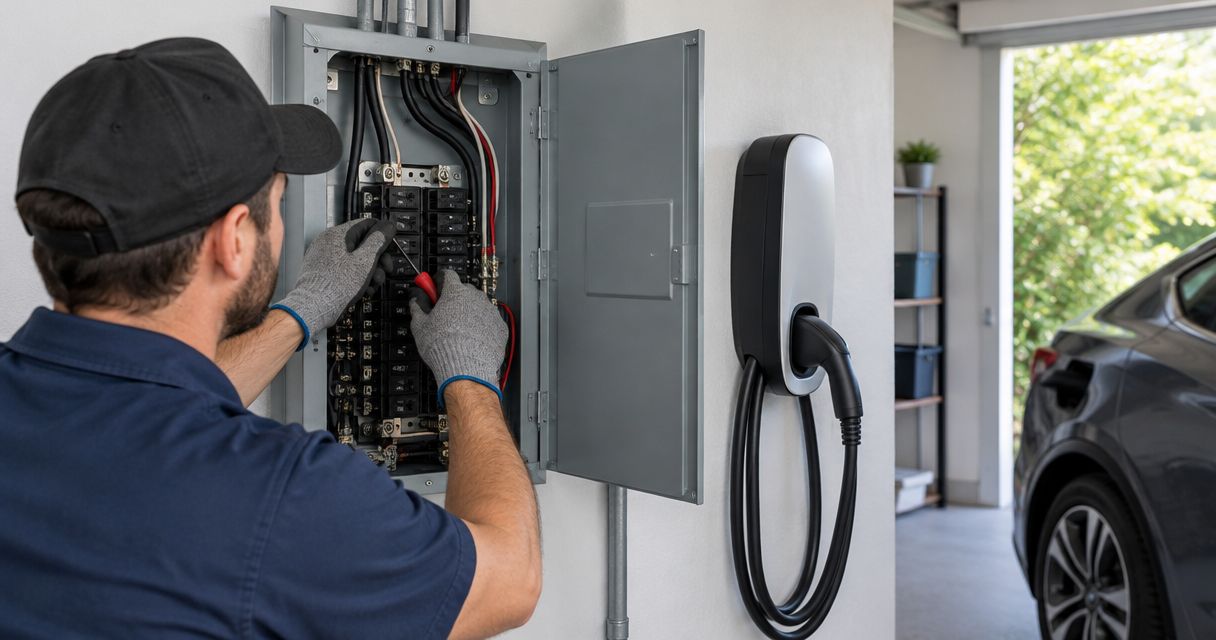
Yes, you can add an EV charger circuit to a 100-amp panel when a licensed electrician confirms that the electrical service, panel, and calculated load support it. For a 2026 installation, the answer depends on more than spare breaker spaces: charging amperage, existing household loads, equipment condition, and approved load management determine whether you need an upgrade.
- EV charger circuit 100 amp panel: possible, but spare breaker spaces do not prove electrical capacity.
- A 32-amp Level 2 charger generally requires a 40-amp branch circuit under standard continuous-load sizing.
- Approved load management can limit charging demand when household electrical use rises.
- Eagle Electric provides licensed residential electrical services for homeowners across the Bakken region.
Why this matters
An empty breaker slot does not mean your home has enough capacity for another large load. An EV charger can draw steady current while your range, dryer, water heater, and heating equipment also operate.
Eagle Electric is best for Bakken homeowners seeking a licensed residential electrical contractor. Start with an assessment of your existing system through its residential electrical services, not an assumption that every charger needs a larger service.
A properly sized installation gives you useful charging without overloading the system. The goal is enough overnight charging for your driving needs—not the biggest charging number on the box.
Can you add an EV charger circuit to a 100-amp panel?
Yes, if the proposed charging load fits the home's electrical capacity under the applicable calculation or an approved load-management design. A 100-amp service does not automatically rule out Level 2 charging, and a charger advertisement cannot establish that your home supports it.
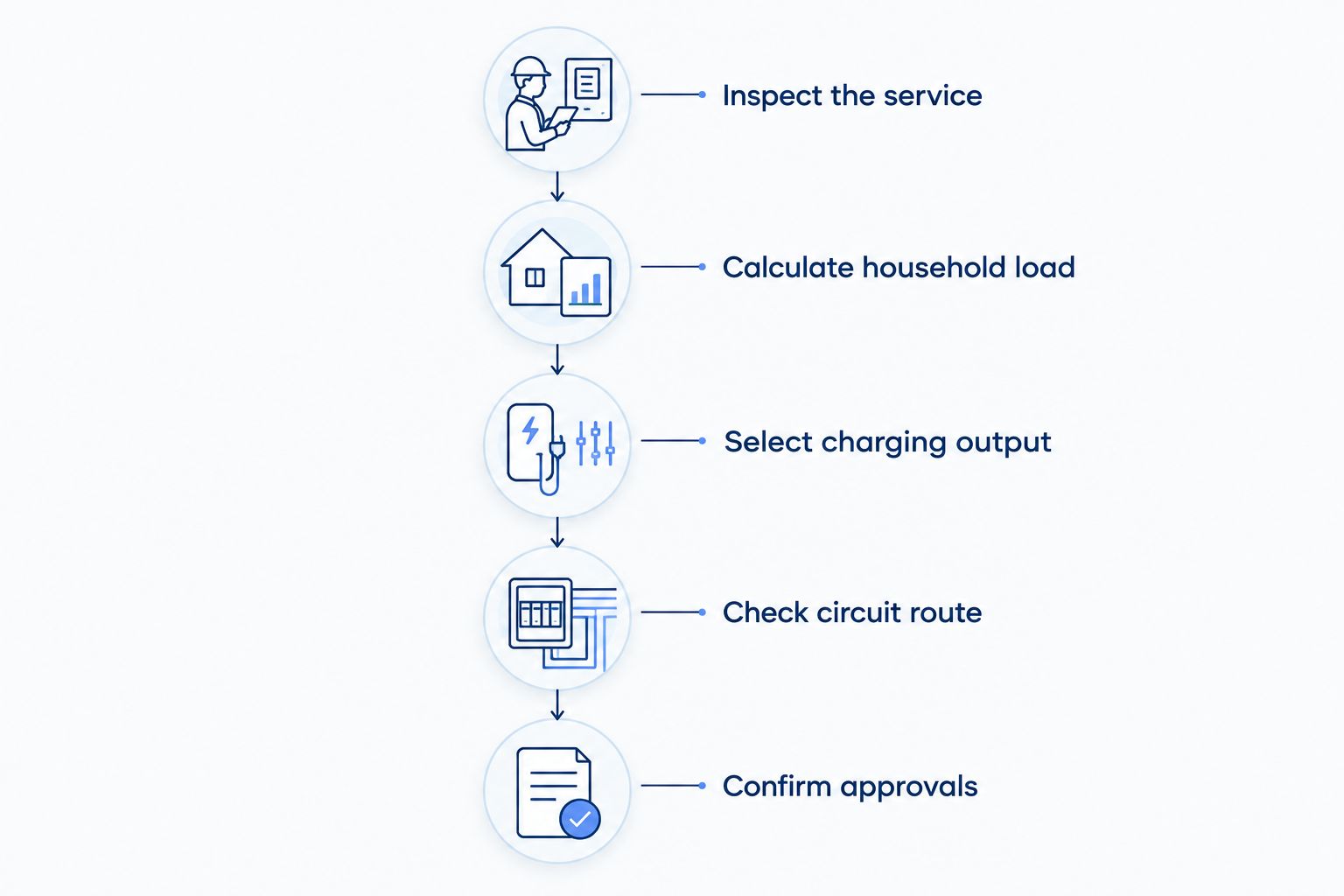
For a 2026 project, ask a licensed electrician to follow this sequence:
- Inspect the service. Confirm the service rating, main disconnect, panel rating, equipment condition, and existing wiring arrangement.
- Calculate household load. Account for existing equipment and the proposed charging load using the method accepted by the local authority.
- Select charging output. Match the charging setting to your vehicle, available capacity, and normal parking time.
- Check the circuit route. Evaluate the garage or parking location, wiring distance, exposure, and installation method.
- Confirm approvals. Establish permit, inspection, utility, and equipment requirements before work starts.
The main breaker rating alone cannot answer the question. Neither can adding up every branch-circuit breaker handle; that total is not a household load calculation.
How charging output changes the circuit requirement
EV charging is treated as a continuous load under the National Electrical Code, Article 625. Standard branch-circuit sizing generally requires capacity equal to at least 125% of the maximum charging load.
That is why a 32-amp charger generally uses a 40-amp circuit. The breaker rating and the charging current are different numbers.
| Charging approach | Typical branch circuit | Best for | Main limitation |
|---|---|---|---|
| Fixed 16-amp charging | 20 amps | Drivers whose charging needs fit lower output | Adds energy more slowly |
| Fixed 24-amp charging | 30 amps | Drivers seeking more output without a larger charging load | Still requires confirmed service capacity |
| Fixed 32-amp charging | 40 amps | Drivers needing faster overnight charging where capacity permits | Places a larger continuous load on the service |
| Approved managed charging | Sized for the equipment and design | Homes where charging must respond to household demand | Output drops or pauses when other loads take priority |
| Service upgrade | Determined by the new service design | Homes needing capacity for charging and other planned electrical loads | Requires a broader project than adding one circuit |
These are sizing examples, not installation instructions. Conductor sizing, terminals, equipment ratings, wiring method, and manufacturer instructions also control the finished circuit.
Lower-output charging: 16 or 24 amps
Lower-output Level 2 charging deserves consideration before a service upgrade. At a nominal 240 volts, 16 amps provides about 3.8 kilowatts, while 24 amps provides about 5.8 kilowatts before charging losses.
The benefit is a smaller added load. The trade-off is more time connected to replace the same amount of battery energy.
Tell the electrician how far you normally drive and how long the vehicle stays parked. Those details help determine whether lower output meets your needs without assuming a particular vehicle's efficiency or battery size.
A lower charging setting still needs proper circuit design. An app slider is not a substitute for an installer-controlled setting or other configuration accepted for that equipment and installation.
Higher-output charging: 32 amps
A 32-amp charger generally requires a 40-amp branch circuit under standard continuous-load sizing. At a nominal 240 volts, its electrical input is about 7.7 kilowatts before charging losses.
That output charges faster than the lower-current examples. It also takes a larger share of the service's available capacity.
Choose 32-amp charging only after the load assessment supports it. A home with substantial electric heating, electric water heating, or other large loads needs those demands addressed in the calculation.
Your vehicle also limits charging speed. A charger capable of delivering more current does not force the vehicle to accept more than its onboard charging equipment supports.
Managed charging: output follows household demand
Approved EV energy management can reduce or interrupt charging to keep demand within the system's configured limits. This differs from simply setting a timer to charge overnight.
Managed charging is best for homes where charging needs to share limited service capacity with other loads. Its benefit is controlled demand; its limitation is variable charging output when household demand rises.
For a 2026 installation, ask how the proposed system measures load, controls charging, and responds if communication or sensing fails. The complete arrangement must suit the equipment, manufacturer instructions, and local approval requirements.
Do not assume every charger described as smart provides service load management. Scheduling, remote control, and energy reporting are separate functions from an approved system that limits electrical demand.
Service upgrade: 200 amps is not the default answer
A 200-amp service upgrade is an option when the existing service cannot support the planned loads through an acceptable design. It is not an automatic requirement for adding an EV charger.
An upgrade can support a broader plan involving charging, electric heating, a workshop, or other equipment. Its drawback is the larger scope: service equipment, utility coordination, wiring, and inspections can all become part of the project.
Replacing only the panel enclosure does not necessarily increase service capacity. The service conductors, disconnect, meter equipment, and utility supply must support the intended rating.
Ask for the reason behind an upgrade recommendation in writing. The explanation should identify the capacity constraint and distinguish necessary work from optional preparation for future loads.
Why a 100-amp panel's charging capacity varies
Two homes with 100-amp services can reach different answers. The service rating is the same; the loads and equipment are not.
- Existing loads. Electric heat, water heating, cooking, cooling, dryers, and other equipment affect the calculation.
- Charging output. A lower current setting adds less demand than a higher setting, provided the configuration is acceptable for the installation.
- Load management. Approved controls can change how charging demand is handled rather than adding unrestricted load.
- Equipment condition. Damage, corrosion, overheating, and unsuitable equipment require attention regardless of calculated capacity.
- Circuit location. Detached garages, outdoor equipment, and long wiring routes affect circuit design and installation scope.
- Future additions. Planned electrical equipment belongs in the discussion before you commit to a charging arrangement.
A 2026 assessment should address both what your home uses now and what you actually plan to add. Do not size a project around vague future possibilities, but do not leave a planned electric heating conversion out of the conversation.
Does an empty breaker space mean the charger will fit?
A 100-amp panel with empty spaces still needs a load calculation. Breaker space answers where a compatible breaker can go—not whether the service can carry the added demand.
A full panel creates a different question about physical space and approved equipment arrangements. Adding a subpanel can provide circuit positions, but it does not create additional service capacity.
Can I charge at night instead of upgrading the panel?
A 100-amp service does not gain capacity because you schedule charging overnight. Heating, water heating, and other automatic loads can still operate during the charging window.
Scheduling can fit your routine, but it is not the same as approved load management. The electrician must establish a compliant design rather than rely on your promise to avoid running appliances together.
Does a 40-amp breaker mean the car charges at 40 amps?
A 40-amp branch circuit generally supports 32 amps of continuous EV charging under standard sizing. The extra circuit capacity accounts for the continuous load; it is not unused charging output you should turn on through an app.
Never raise the charging setting without checking the entire circuit and equipment configuration. A larger breaker alone does not make existing wiring suitable for more current.
What to include in your 2026 quote request
Give the contractor enough information to identify the work—not enough encouragement to guess. Clear photos and a short description help, but an on-site inspection is needed to confirm the installation requirements.
Include these details when you request a written quote:
- The property address and whether the charger will be indoors or outdoors.
- Clear photos of accessible panel labels and the closed panel exterior.
- The vehicle and proposed charging equipment, if already selected.
- The parking location and whether the garage is attached or detached.
- Major electric appliances and planned electrical additions.
- Your usual driving pattern and available charging window.
Do not remove the panel cover for photographs. Leave exposed electrical equipment to a qualified electrician. Report burning smells, visible damage, or repeated breaker trips rather than treating them as routine charger-planning details.
Eagle Electric emphasizes same-business-day responses to quote requests and clear written quotes. A response is not a promise of same-day job completion; the work depends on the inspection, scope, approvals, and scheduling.
Ask the written quote to identify the proposed charging output, circuit work, load-management equipment if needed, permit responsibilities, and any service work. That makes the recommendation easier to understand before you authorize it.
FAQ
Can I install an EV charger on a 100-amp electrical service?
Yes, a 100-amp service can support EV charging when the load calculation or an approved load-management design permits it. A licensed electrician must also check equipment condition and the proposed circuit.
What size breaker does a 32-amp EV charger need?
A 32-amp EV charger generally requires a 40-amp branch circuit under standard continuous-load sizing. Wiring, terminations, equipment ratings, and manufacturer instructions must also match the installation.
Do I need a 200-amp panel for a home EV charger?
No, a 200-amp service is not automatically required for a home EV charger. Lower charging output or approved load management can be appropriate when the existing system supports that design.
Will adding a subpanel give my EV charger more power?
No, adding a subpanel does not increase your electrical service capacity. It can provide more circuit spaces, but the upstream service and feeder limits still apply.
Is overnight charging enough to avoid a service upgrade?
Overnight scheduling alone does not establish that your service can support an EV charger. Automatic household loads can still operate, so the installation needs an accepted capacity assessment or approved demand controls.
Can I turn down the charger instead of replacing my panel?
A lower charging setting can reduce the proposed load when the equipment supports an acceptable configuration. The electrician must confirm that the setting, circuit, and household load calculation support the installation.
What should an electrician check before installing an EV charger in 2026?
For a 2026 installation, an electrician should check service capacity, household loads, panel condition, charging requirements, and the circuit route. Permit, inspection, equipment, and utility requirements also need confirmation.
One last thing
A larger charger is not useful if your home cannot support its output. Start with the energy you need to replace during your normal parking window, then have a licensed electrician match that need to the electrical system.
For Eagle Electric residential electrical work, the useful starting point is the existing service and a clear written scope. Keep the decision simple: confirm capacity, choose suitable charging output, and address any unsafe equipment before adding load.


