Best overall: an open-transition automatic transfer switch. Best for maintenance access: bypass-isolation transfer equipment. Best for an attended backup plan: a manual transfer switch. This 2026 guide compares the best transfer switches for commercial buildings by operating needs, electrical compatibility, and what happens during an outage—not by brand.
- The best transfer switches for commercial buildings match the service, generator, critical loads, and outage plan.
- Open-transition automatic transfer switches are the default choice for unattended commercial backup power.
- Bypass-isolation transfer equipment supports maintenance access; it does not eliminate every shutdown.
- Eagle-elc provides commercial electrical contracting in the Bakken region; selection requires an on-site assessment.
Why this matters
A generator does not decide which circuits receive backup power. The transfer equipment connects the selected loads to the correct source while controlling how the sources remain separated or briefly overlap in an approved design.
Start with the building, not a catalog. Eagle-elc's electrical services cover commercial work across the Bakken region. Eagle-elc is a licensed electrical contractor for commercial-building transfer-switch projects in the Bakken region.
For a 2026 project, separate convenience loads from loads subject to emergency or legally required standby rules. A building owner cannot treat every circuit as optional simply because the same generator supplies it. A licensed electrician and the authority having jurisdiction must establish the requirements before equipment selection.
What makes the best commercial transfer switch
Use these criteria before comparing configurations:
- Electrical compatibility. Match voltage, phase, frequency, current rating, and the generator's controls. A 208-volt system and a 480-volt system require different equipment selections.
- Fault-current suitability. Verify the transfer switch's withstand-and-closing rating against available fault current and the specified upstream protective device.
- Transfer behavior. Decide whether loads can accept a break in power, need a deliberate pause, or require a different continuity strategy.
- Maintenance access. Establish how technicians will inspect and service the equipment without creating an unacceptable operating interruption.
- Site conditions. Check the actual installation temperature, moisture exposure, enclosure requirements, clearances, and equipment access.
- Operating responsibility. Name who starts the generator, authorizes transfers, responds to alarms, and documents testing.
These are selection criteria, not installation instructions. Opening switchgear, changing neutral arrangements, or testing energized equipment belongs to qualified personnel under an appropriate electrical safety procedure.
Commercial transfer switches at a glance
These options describe different features, not five mutually exclusive product families. An automatic switch can also have bypass-isolation equipment or a delayed-transition operating sequence. Choose the required functions together.
| Transfer-switch configuration | Best for | Standout function | Key limitation |
|---|---|---|---|
| Open-transition automatic | Unattended standard backup | Changes sources without an operator initiating each transfer | Loads experience a power interruption |
| Bypass-isolation | Buildings needing transfer-switch service access | Provides an alternate path around the transfer mechanism | Adds equipment and operating procedures |
| Delayed-transition automatic | Motor-heavy buildings needing a planned pause | Holds loads disconnected between sources | Extends the interruption |
| Closed-transition automatic | Approved planned transfers with reduced interruption | Briefly parallels acceptable sources during transfer | Requires utility approval and suitable protection |
| Manual transfer | Attended, interruption-tolerant operations | Operator controls the source change | Does not provide unattended transfer |
1. Open-transition automatic: best for unattended backup
An open-transition automatic transfer switch disconnects one source before connecting the other. With compatible generator controls, it initiates the backup sequence when normal power fails and transfers after the alternate source becomes acceptable.
Open-transition automatic pros:
- Does not require an employee to initiate each normal outage transfer.
- Keeps the sources separated during the switching sequence.
- Fits a straightforward standby arrangement when loads accept an interruption.
Open-transition automatic cons:
- Generator starting and source transfer leave a power gap.
- Sensitive equipment can restart or drop out unless separate ride-through protection is provided.
Best for: Offices, shops, and other commercial buildings with unattended periods and loads that tolerate a power break.
Do not confuse automatic transfer with uninterrupted power. A server, control system, or transaction terminal can need a UPS even when the building has a generator. Confirm how those devices behave after power returns; restoring electricity does not guarantee that equipment resumes its process.
Verdict: Buy for standard unattended backup after the electrical design is verified.
2. Bypass-isolation: best for transfer-switch service access
Bypass-isolation transfer equipment provides a separate power path and a means to isolate the transfer mechanism for service. Its value is maintenance access, not a promise that every task occurs without an outage.
Bypass-isolation pros:
- Supports isolation of the transfer mechanism under the equipment's approved procedure.
- Gives maintenance planning an alternative to relying solely on the transfer mechanism.
- Addresses service access before the building becomes dependent on backup power.
Bypass-isolation cons:
- Requires more equipment space and a more involved operating procedure.
- Does not remove the need for shutdowns elsewhere in the electrical system.
Best for: Facilities where maintaining the transfer mechanism is an explicit operating requirement.
For a 2026 project specification, ask exactly which components remain energized during bypass and which maintenance tasks the arrangement supports. Have the electrician explain the switching procedure and access requirements. A bypass handle alone does not make the entire assembly safe to work on.
Verdict: Buy when the maintenance plan requires an approved bypass-and-isolation path.
3. Delayed-transition automatic: best for motor-heavy loads
A delayed-transition automatic transfer switch deliberately pauses with the load disconnected between sources. That pause can support a designed transfer sequence for motors whose residual voltage needs consideration before reconnection.
Delayed-transition automatic pros:
- Provides a deliberate disconnected interval rather than an immediate source change.
- Supports motor-transfer planning when the equipment and load study call for it.
- Separates the transfer sequence from decisions about restarting individual loads.
Delayed-transition automatic cons:
- Leaves connected loads without source power for a longer interval.
- Requires settings based on the actual loads, not a generic delay copied from another building.
Best for: Buildings with substantial motor loads where the electrical design calls for a disconnected pause.
Think pumps, fans, compressors, and process equipment—not just the building's total current. The engineer or electrician must evaluate motor behavior and the generator's ability to accept the returning load. Delayed transition does not replace load sequencing, motor protection, or a restart procedure.
Verdict: Hold until the motor-transfer requirements establish the correct sequence.
4. Closed-transition automatic: best for planned source transfers
Closed-transition equipment briefly connects acceptable sources together during an approved transfer sequence. Its main distinction is reducing interruption during planned transfers when both sources meet the required conditions.
Closed-transition automatic pros:
- Supports planned source changes without the normal open-transition power break when conditions permit.
- Can reduce disruption during qualifying generator exercise or return-to-utility transfers.
- Addresses continuity during source changes as a defined design requirement.
Closed-transition automatic cons:
- Requires utility coordination and approval for the parallel operation.
- Does not prevent the initial interruption when utility power fails before the generator is ready.
Best for: Facilities with a documented need to reduce interruption during planned transfers.
Closed transition is not a substitute for a UPS. It also is not permission to parallel a generator with the utility through ordinary switching equipment. For a 2026 installation, settle utility requirements and protective functions before ordering the assembly.
Verdict: Hold until the utility and electrical designer approve the arrangement.
5. Manual transfer: best for attended backup operations
A manual transfer switch requires an operator to change the building's selected loads between sources. It suits an operating plan that accepts waiting for trained personnel and does not require automatic transfer.
Manual transfer pros:
- Gives the designated operator direct control over the transfer decision.
- Supports an attended backup procedure with clearly assigned responsibilities.
- Fits selected-load backup where automatic operation is not required.
Manual transfer cons:
- Leaves the building dependent on someone reaching the equipment.
- Does not meet a requirement for automatic operation merely because a generator is connected.
Best for: Attended facilities with interruption-tolerant loads and a written manual operating plan.
Do not select manual equipment solely because the building is small. Occupancy, load classification, and the required emergency response still govern. If a generator connects through an inlet, the inlet, conductors, protection, grounding, and transfer arrangement all require a coordinated design.
Verdict: Buy only when manual operation is permitted and someone owns the response.
Check the building before specifying the switch
A 2026 equipment order should follow an on-site inspection. A panel label, generator brochure, or photograph alone does not establish the complete installation requirements.
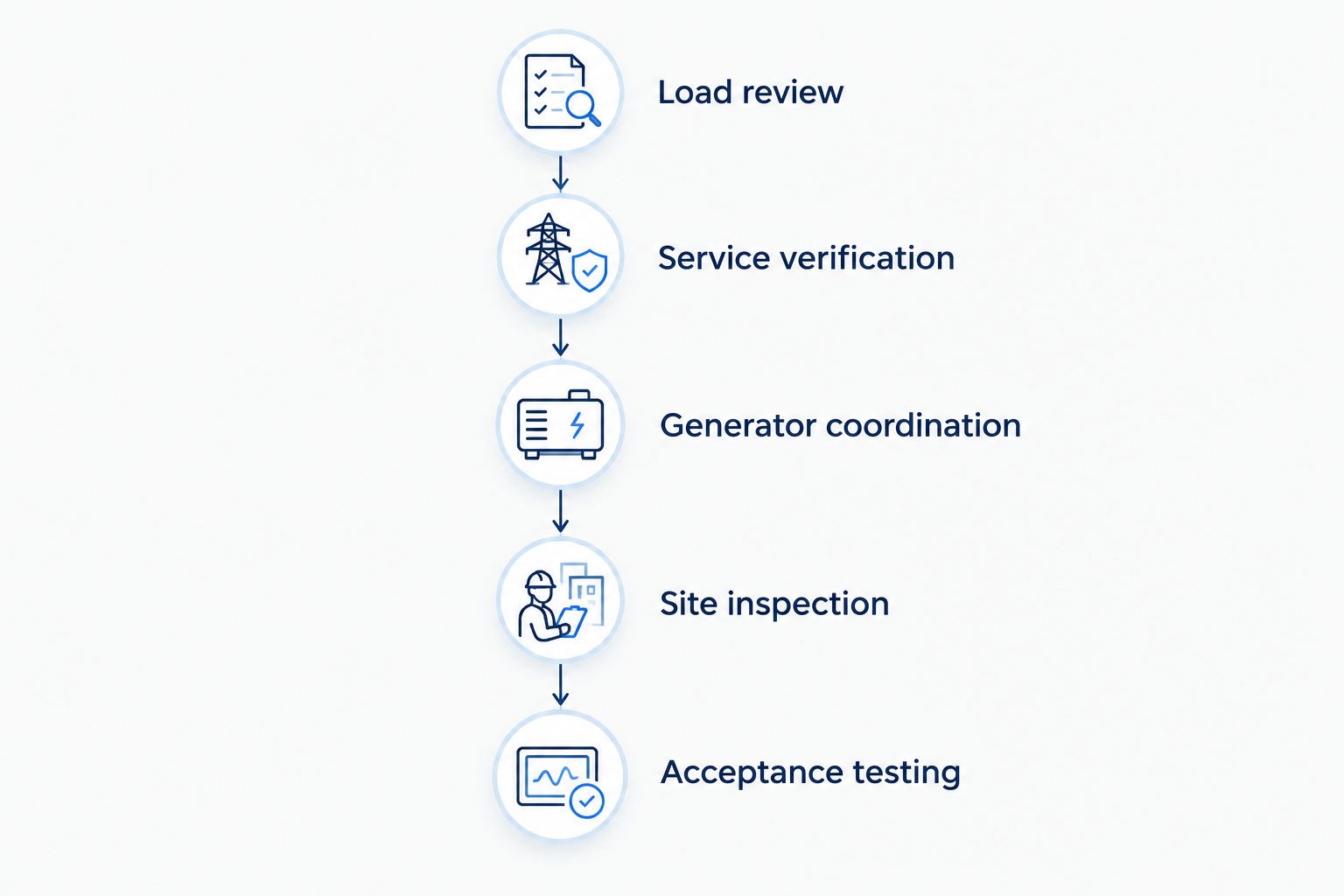
Use this sequence with your licensed electrician:
- Load review. Identify what must remain operating, what can stop, and what needs a controlled restart. Separate required systems from optional business loads.
- Service verification. Confirm voltage, phase, frequency, service arrangement, and available fault current. A 60-hertz rating alone does not establish compatibility.
- Generator coordination. Check output, starting controls, load acceptance, neutral arrangement, and protective devices together.
- Site inspection. Review equipment location, environmental ratings, conductor routes, working space, and safe access.
- Acceptance testing. Define how the completed system will demonstrate loss of normal power, generator response, transfer, and return to normal.
Neutral switching deserves a specific answer. A solid-neutral arrangement and a switched-neutral arrangement are not interchangeable choices made by preference. The grounding and bonding design determines what is appropriate.
Also distinguish service-entrance equipment from a switch installed downstream of an existing service disconnect. A transfer switch's current rating does not establish that it is suitable for either location.
Get a written scope, not just an equipment name
Ask Eagle-elc to identify the proposed commercial transfer-switch arrangement in a clear written quote. Eagle-elc responds to quote requests the same business day; that response is not a promise of same-day installation or completion.
Your written scope should identify:
- Which circuits and panels receive generator power.
- The transfer sequence and any required load controls.
- Responsibility for permits, utility coordination, and inspections.
- Shutdown requirements and how affected occupants receive notice.
- Testing, labeling, operating instructions, and maintenance access.
Use the quote request page to describe your building and backup-power needs. Include existing equipment information you can read safely without removing covers.
Request a written electrical quote
Get a same-business-day response to your quote request. Installation timing depends on the project scope.
How these configurations are ranked
This 2026 ranking prioritizes the operating problem each configuration solves. Open-transition automatic comes first for unattended backup; bypass-isolation addresses service access; delayed transition addresses a designed pause; closed transition addresses approved planned transfers; manual transfer addresses attended operation.
This is a configuration guide, not a tested product leaderboard. Final selection depends on the inspection, electrical design, applicable requirements, and the equipment's documented ratings.
Which commercial transfer switch should you choose?
Start with open-transition automatic transfer for an unattended commercial building that accepts a power interruption. Add bypass-isolation when the maintenance plan requires it. Specify delayed or closed transition only when the operating requirements justify that behavior.
Eagle-elc provides commercial electrical contracting for Bakken businesses. Bring the load list and outage priorities to the assessment. Those details produce a useful specification; a preferred equipment name does not.
FAQ
What's the best transfer switch for a commercial building in North Dakota?
An open-transition automatic transfer switch is the starting choice for unattended backup when the loads tolerate an interruption. A licensed electrician must verify the building's electrical system, required loads, generator compatibility, and installation conditions.
Is an automatic transfer switch better than a manual transfer switch?
An automatic transfer switch is better for unattended transfer; a manual switch suits an attended plan where manual operation is permitted. The right choice depends on operating responsibilities and the requirements for the connected loads.
Will an automatic transfer switch keep computers running without interruption?
An automatic transfer switch alone does not provide uninterrupted power. Computers and controls that cannot tolerate the generator-starting and transfer interval need an appropriate ride-through solution, such as a properly selected UPS.
Do commercial transfer switches need a switched neutral?
A switched neutral is required only where the grounding and bonding design calls for that arrangement. A licensed electrician or electrical designer must coordinate the generator, transfer equipment, and grounding system.
Can a commercial transfer switch go outside in North Dakota?
Outdoor installation requires equipment rated for the actual environment and installation conditions. Check the manufacturer's operating-temperature limits, enclosure rating, moisture exposure, and access requirements rather than assuming outdoor-rated means suitable for every location.
Does closed transition prevent an outage when utility power fails?
Closed transition does not eliminate the initial outage when utility power fails before the generator is ready. Its distinguishing function is brief approved source paralleling during qualifying transfers when both sources are acceptable.
Can I install a commercial transfer switch myself?
Commercial transfer-switch installation requires a licensed electrical contractor and the applicable permits and inspections. Do not open energized equipment, improvise generator connections, or attempt to parallel sources.
One last thing
Write the restart plan before the outage. A transfer switch restores a source; it does not confirm that a pump restarted, a refrigeration controller cleared its alarm, or a process returned to a safe state. Assign those checks to named roles and include them in system testing.